Their support makes the Summit possible, and the relationship has always been a partnership built on trust and long-term commitment.
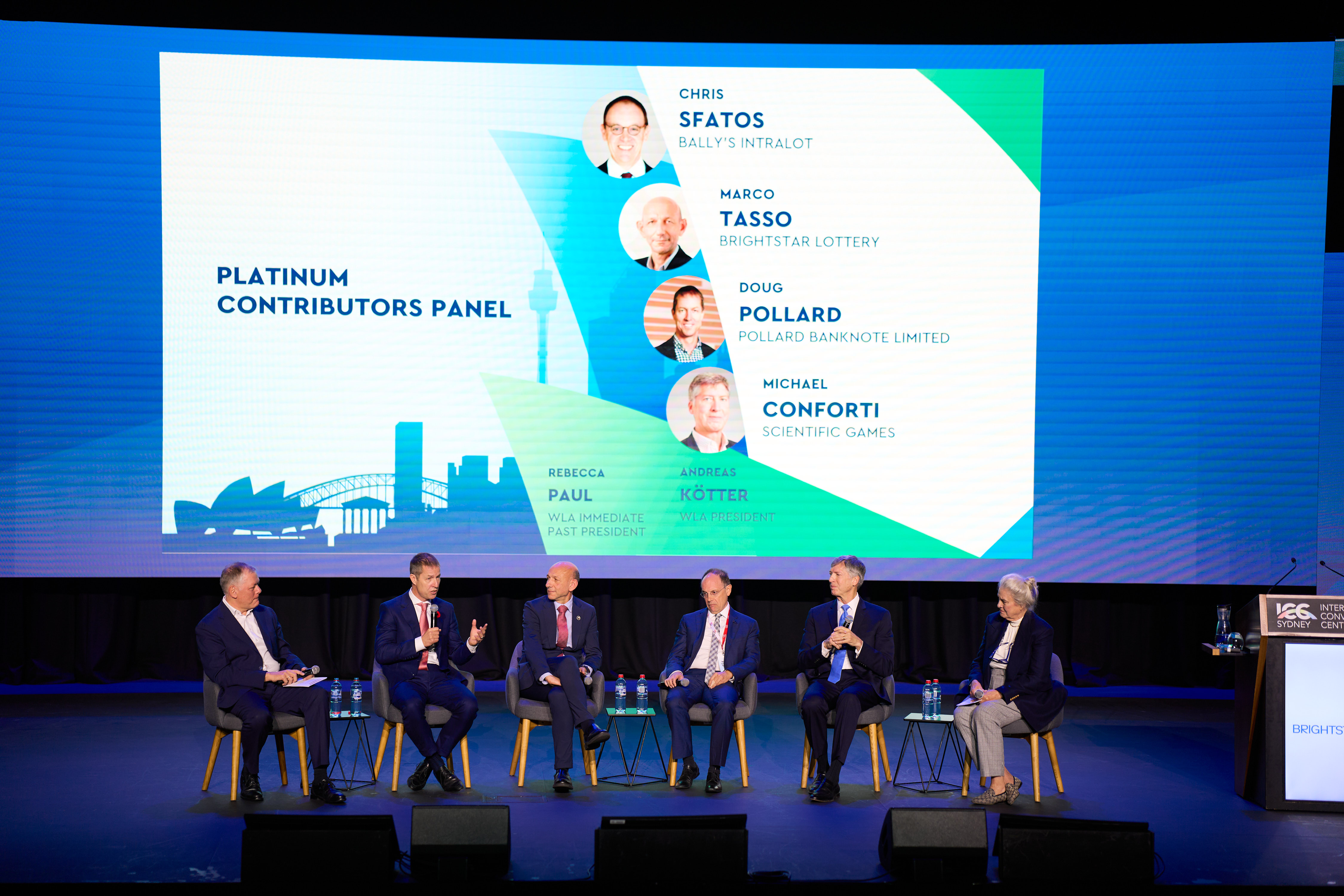
The WLA President, Andreas Kötter and CEO of the Tennessee Lottery, Rebecca Paul, co-moderated the session with panelists:
- Chris Sfatos, President Lotteries & Group COO, Bally’s Intralot
- Marco Tasso, Executive Vice President and COO, Global Lottery, Brightstar Lottery
- Doug Pollard, Co-Chief Executive Officer, Pollard Banknote
- Michael Conforti, President, International, Scientific Games
Investment in a converging market
Prediction markets, fantasy sports and other hybrid products are attracting capital and attention. Investors now compare lottery suppliers with gaming, entertainment and fintech companies.
How is the evolution towards a converging market shaping investment priorities, and how are financial markets and investors reassessing the lottery sector?
In an era of continual and rapid technological evolution, which has enabled the lottery and sports betting industry to reach many more customers than ever before, investors want to see adaptability, the ability to innovate rapidly and offer consumers different experiences. This is even more vital when consumers can look to prediction markets to bet on anything at any time.
While content is important, it was underscored that data handling was more so in terms of gathering and analyzing, in order to enhance the value proposition to the customer, all of which requires systems that can integrate AI technologies across operations.
With the main objective of raising money for good causes, it was highlighted that our industry resonated with younger audiences who want to support good causes for social benefit. This importantly requires creating highly personalized journeys to which they have become accustomed.
Finally, investment in the retail vendors, who can grow the business and respond to the many changes in a timely manner is key.
AI and the resilience of business models
AI is continually changing business operations and lowering the barriers to entry for new competitors.
How is artificial intelligence changing how products are designed, operations are run and players are engaged?
There was a consensus that AI plays a big role in advancing the industry, by improving speed to market, innovating content, player protection, and enhancing operations.
However, while still in the early stages, it still requires human oversight at all times, constant adaptability and new forms of agility.
Predictive maintenance will change customer support.
Competitors are deploying AI and the industry must be ready for how they will use it and be able to react rapidly. For instance, the lotteries are unique in that they offer life changing prizes, but will others also develop this in time?
With rapidly evolving markets and technology disrupters, the lottery and sports betting industry has its work cutout to remain relevant and sustainable for the next generations.
Are the lotteries future proof?
This question elicited differing views. On the one hand it was argued that with three key points in our favor: Customer trust – thanks to our highly regulated industry; good causes – the unique contribution made by our industry, worldwide; and potentially life-changing games, the industry could secure its future, if these aspects were kept at the core together with continued rapid innovation.
On the other, it was noted as not necessarily the case, given the proliferation of new digital gaming, and prediction markets, added to the regulatory limitations to which state-regulated operators must adhere.
The lotteries must ensure regulators understand this situation, of the lotteries needing to balance developing entertaining products, within the jurisdiction’s regulations, and protect it.
Staying relevant to safeguard returns to good causes
Returns to good causes are the core purpose of lotteries and what sets them apart from other gaming operators. Protecting that purpose requires lotteries to remain attractive to new generations of players, in a market where new products and technologies spread very quickly.
How is the balance maintained of contributing to good causes in the fast-moving world, that cannot be kept up with?
It was agreed that the lotteries could not compete with prediction markets, but with a global product and global reach, must fully understand their customers and deliver the products and services they want in a timely manner.
Though a key focus is on digital, the lotteries have the advantage of their retail outlets, but must keep customers in both mediums by ensuring seamless movement between the two.
Finally, with the rapid rise of prediction markets, the lotteries must engage more with regulators, to ensure the industry's protection.