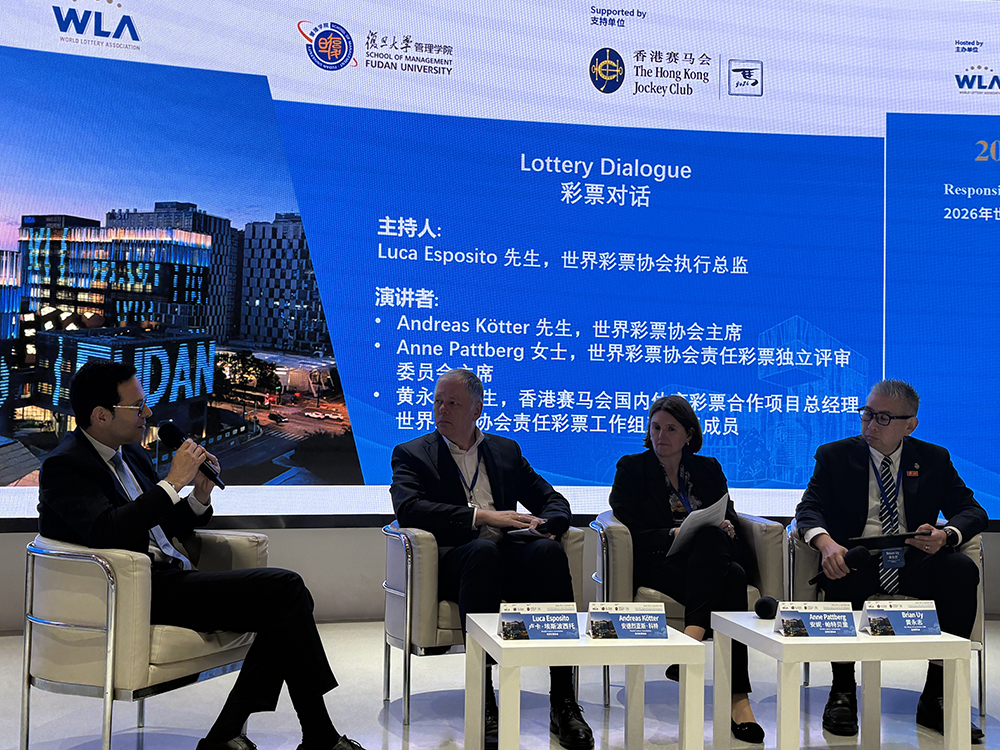
During the WLA Seminar on Responsible Gaming and Security and Risk Management, held in Shanghai, China, from 23-24 April, a panel of experts, moderated by WLA Executive Director, Luca Esposito, examined the question of how regulated operators should respond when their environment continues to evolve faster than many traditional market and governance models were designed for.
A continually evolving sector
Elaborating on the current global situation, of converging factors, such as:
Growing illegal gambling, sophistication and digital reach, which affects consumer protection, public revenues, and the credibility of regulated frameworks.
New forms of channel leakageand grey-area activity, such as lottery courier services, which raise difficultquestions around authorization, accountability, customer protection and marketintegrity.
Artificial intelligence, which can help operators improve monitoring, service and detect issues earlier, however, it can also create new risks in fraud, impersonation, manipulation and trust.
Esposito noted that for regulated operators it was not only a question of competition, it was about ensuring legitimacy, player protection, governance, and long-term public confidence.
Industry-policy perspective
Panelist Andreas Kötter, WLA President, and CEO of WestLotto, provided a strategic overview for addressing the challenges.
In an increasingly complex, more fragmented, operating environment it is harder to govern with traditional assumptions, and the regulated model matters, more than ever, with its key focus on accountability.
“Our task is to prove that the regulated lottery model can remain relevant, innovative and trusted at the same time.”
Kötter underscored that the regulated lottery model must maintain its integrity and social responsibility which involves taking measures to combat illegal gambling that threatens revenue and consumer safety, and by addressing accountability in new intermediary models, such as courier services.
It is paramount for the sector to adopt responsible, AI-driven innovation and cross-border cooperation, to counteract transnational illegal operators, through industry platforms that allow legal operators to share intelligence, align understanding and develop stronger collective responses, to remain relevant and sustainable.
Responsible Gaming and instilling trust
Anne Pattberg, Chair of the Independent Assessment Panel, which reviews all RG certification submissions, offered her insights on responsible gaming, stakeholder trust and social legitimacy.
The evolution of AI and growing illegal gambling has fundamentally changed the landscape of risk, requiring regulated lottery operators to adopt a more holistic, transparent, and evidence-based approach to responsible gaming.
Modern responsible gaming has shifted from simple messaging to a "mature"model, in which operators are expected to integrate safety into every level oftheir business for:
- Design and culture: moving safeguars into product design, internal governance and corporate culture.
- Evidence of impact: moving beyond intent to proving that protection measures work.
Pattberg described three key shifts, in which: digital play is now continuous and integrated into daily life, unlike traditional, contained lottery participation; AI and illegal operators create "grey areas" that look legitimate, making it harder for players to identify risks and protections; and while AI maybe able to identify risks early, its ability to optimize engagement may outpace current consumer protection frameworks.
In concluding, she emphasized the point that lotteries often fund public social benefits and are therefore held to a higher standard than the broader market.
For this reason, operators must ensure players understand the risks and that specific individuals are responsible for product supervision; match stronger safeguards to higher-intensity games, and use data to demonstrate effectiveness and build long-term social license.
Building credibility through deep engagement with regulators, researchers, and the public is vital for survival in a noisier, high-risk market.
“The real challenge is to make sure that new technologies and new market pressures are assessed not only for commercial implications, but also for their impact on player understanding, consumer protection, public trust and long-term legitimacy.”
Public policy, institutional legitimacy, and long-term social value
Raymond Tam, Executive Director, Corporate Affairs of The Hong Kong Jockey Club, talked about ways for regulated operators to approach the previously discussed global market changes.
He explained that when considering governance, public confidence, and social acceptability, illegal gambling remained one of the most serious challenges confronting the sector, because it did not merely compete with legal operators; it weakened the whole public-policy logic behind regulated channels.
Legal lottery and betting systems are expected to apply safeguards, uphold integrity, support orderly market behavior, generate public returns, and many cases, contribute directly to wider social and community objectives, while illegal gambling does none of these things.
“The issue is not only commercial leakage. It is also institutional leakage.”
If demand moves into unregulated or weakly regulated spaces, consumer protection is weakened, public confidence is eroded, and the broader social purpose of the regulated model comes under pressure.
Tam highlighted the uniquely integrated business model operated by the HKJC, which combines racing and racecourse entertainment, membership, responsible sports wagering and lottery, and charities and community contribution, generating economic and social value, while supporting the HKSAR Government in combating illegal gambling.
The regulated model has never been more relevant particularly in relation to evolving technologies and innovation and according to Tam, the approach should be one of innovation within a trusted governance model, which includes:
- Clear public purpose. Why does the regulated channel exist, and what broader value does it serve?
- Credible safeguards. How are player protection, integrity, and risk control made real in practice?
- Institutional discipline. Can the operator demonstrate that it has the culture, systems, and accountability to manage complexity responsibly?
- Open but structured dialogue. No single jurisdiction or operator can resolve these questions alone.
Why WLA matters
Tam concluded that platforms such as WLA matter, because they help connect different markets, legal systems, and operating experiences into more useful collective understanding.
Having legal status is not enough. The future of the regulated sector will be secured by continuing to prove why legality matters, in other words, that legal operators are more responsible, trusted, disciplined, and valuable to society than the alternatives.
“If we can continue to do that, then the challenges we are discussing today can also become an opportunity to reaffirm the long-term relevance of the regulated, accountable, and socially connected model.”