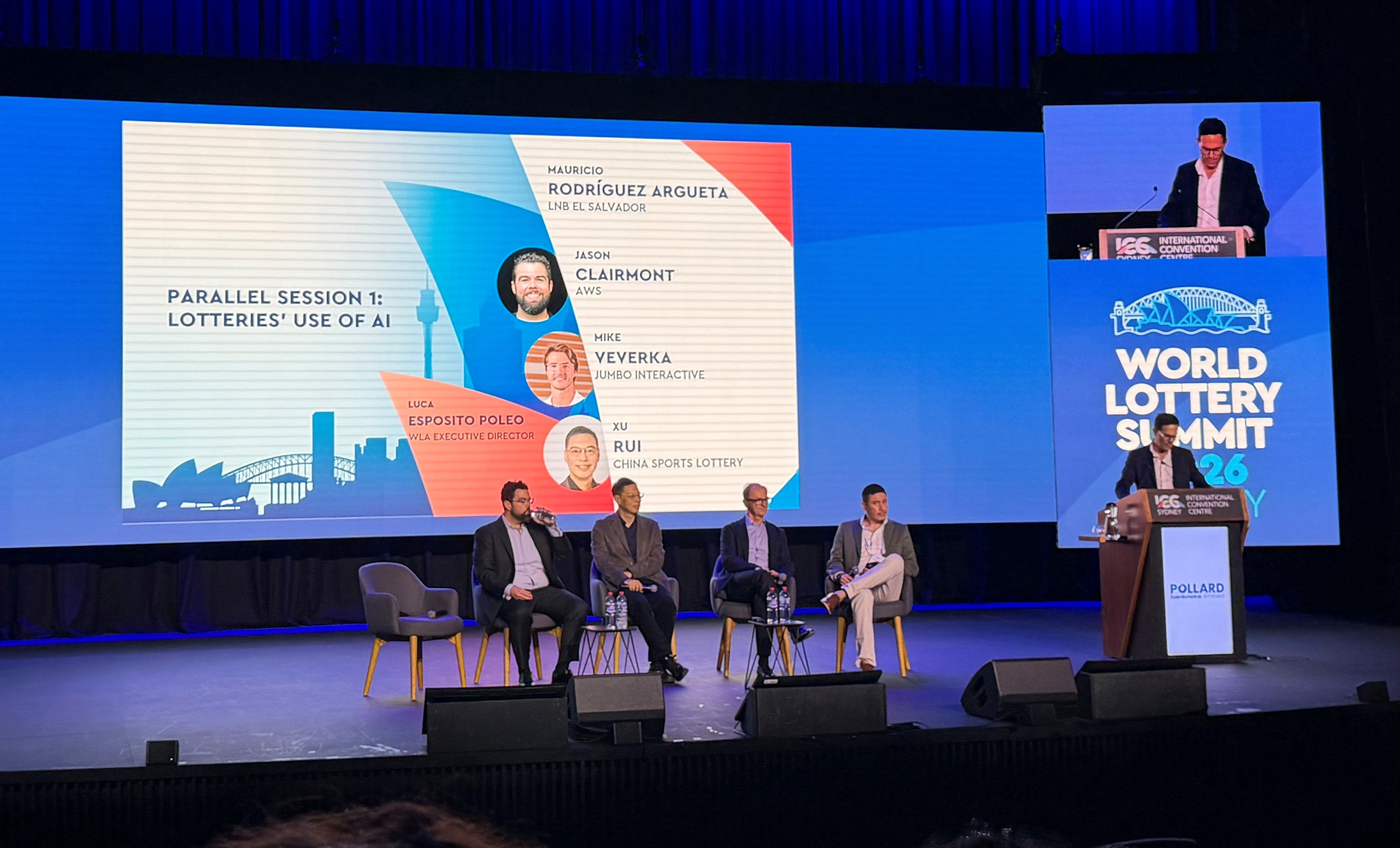
During the first parallel session at the World Lottery Summit 2026, on the topic of AI in the lottery and sports betting industry, moderator and WLA Executive Director, Luca Esposito Poleo, noted an interesting situation in the lottery and sports betting industry revealed in a recent study published by the University of Nevada, Las Vegas, in collaboration with KPMG: AI adoption is accelerating, however the structures needed to manage it responsibly are not necessarily keeping pace.
“It is no longer about what AI could do, rather what it is already doing for industry, the results it is delivering, and what related challenges are being faced.”
Esposito Poleo cited examples of AI implementation at WLA lotteries in Africa, Asia, Europe, Latin America and North America and a key WLA initiative in collaboration with the University of Lausanne, through its School of Criminal Justice, to develop a standardized, transparent and reproducible methodology for estimating the size of illegal gambling markets.
Addressing a fundamental challenge: the scale and impact of illegal gambling, for which credible and comparable estimates across jurisdictions have been lacking.
The methodology has already been tested across six jurisdictions, demonstrating the potential for a common approach.
“For us, this is an important example of how data, research and technology can help address challenges that no single operator can solve alone.”
Panelist perspectives
Moderated by WLA Executive Director, Luca Esposito Poleo, the panel discussed challenges, risks, and experiences of implementing AI solutions. Panelists included:
Mauricio Rodríguez Argueta, Technology and Networks Advisor to the Presidency of El Salvador and IT Manager of the National Charity Lottery (LNB) of El Salvador.
Jason Clairmont, lead for Betting & Gaming industry strategy at Amazon Web Services.
Mike Veverka, CEO and founder of Jumbo Interactive.
Xu Rui, Director of the Operation Management Department, China Sports Lottery Administration Center.
Q & A
Lotteries exist to serve the public interest and contribute to society. How do we make sure that the AI we deploy, stays aligned with that mission?
Mike Veverka: Make it as easy as possible for the customer by deploying AI solutions. This will increase participation in lotteries. Looking ahead this could mean ensuring that AI is able to buy products for customers directly from lottery websites and apps.
Jason Clairmont: This industry attracts people who want to support good causes. AI will assist employees who use it more in daily work activities and improve operations and ultimately enhance the support of good causes.
Mauricio Rodriguez Argueta: AI advances lottery operations but it is important to keep humans in the loop when it comes to key decision making.
Given the different sizes and resources of lottery operators, do you believe the future lies in developing AI solutions internally, relying on external technology partners, or sharing capabilities across the industry?
Xu Rui: in order to achieve reliable operations it is best to develop AI solutions in house, to maintain control. It is important to build inhouse experience through data learning and model tuning, see what is possible and then build the required solution, which is what we do.
Mike Veverka: try developing the AI yourself first, test it and learn from mistakes before deploying it. Many models already exist, so select the right models and tools for your needs.
Jason Clairmont: find the best AI team, upscale these people so that they evolve with the technology throughout your organization.