The session was moderated by Jean-François Bergeron, President and CEO, Loto-Québec, Canada, with panellists:
- Ionuț-Valeriu Andrei, General Manager, Loteria Română, Romania
- Isabelle Jean, Executive Vice-President and Chief Operating Officer, Lotteries, Loto-Québec, Canada
- Jayson Torres, Deputy Director, Lotería Electrónica, Puerto Rico
- Avi Levy, Marketing Manager and luxury foreign affairs, Mifal HaPais, Israel
- David Roy, International Business Development Director, Carmanah Signs
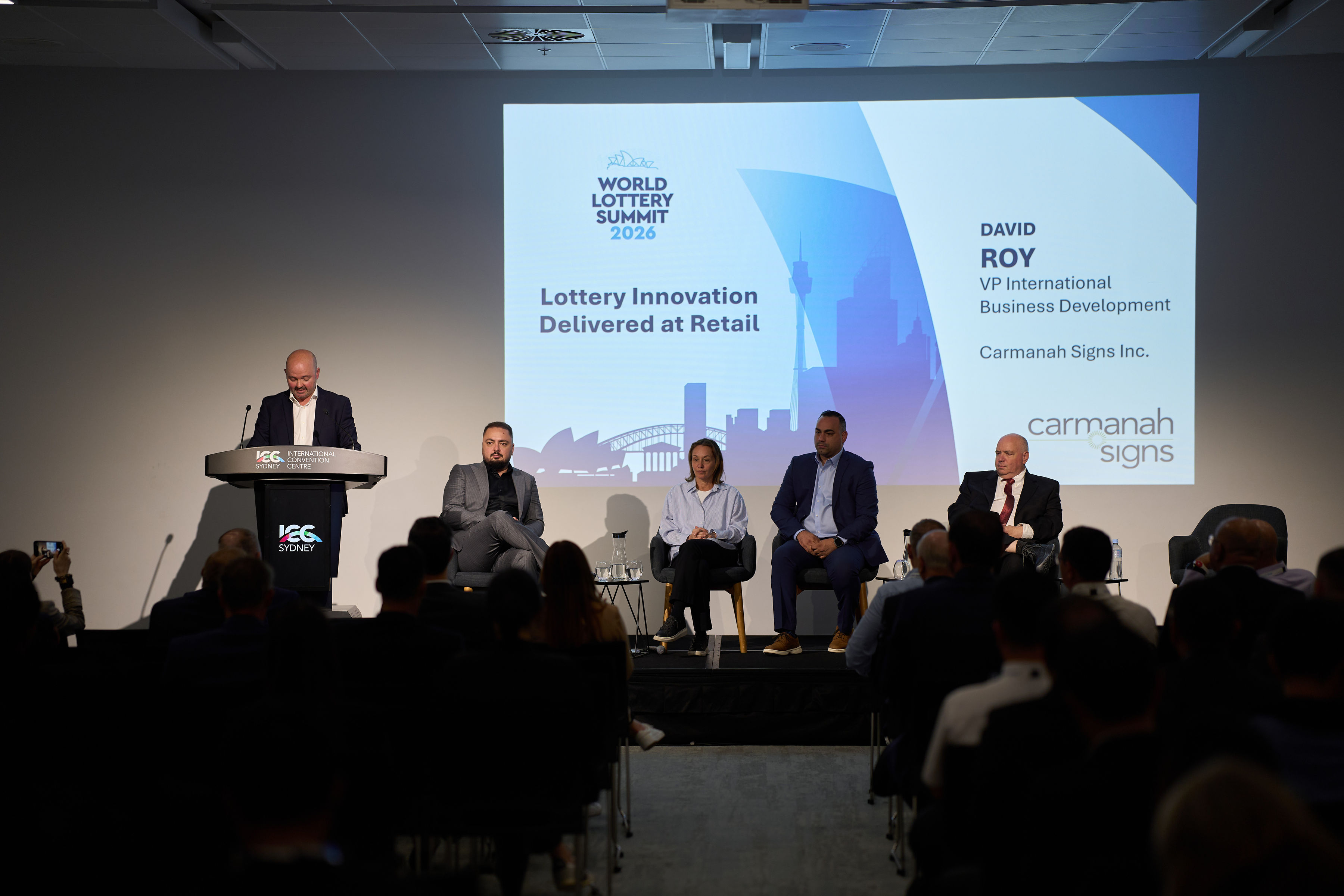
Bergeron opened the discussion by calling attention to a core challenge for today’s lotteries. For younger generations, the lines between gaming, gambling and entertainment are becoming less clear.
"Innovation is much more than creating new games. It's about how we connect with players, how we cange the way we work, and how we adapt to a world that keeps moving."
Loteria Română, Romania
When Andrei took over Loteria Română in 2022, it sold only through land-based retail. The pandemic, when stores had to close, had shown how much the lottery needed an online channel. Building one as a public company under strict regulation could take one to two years, so the lottery chose to "think fast and act fast".
It partnered with apps that already had large user bases, starting with a parking app with more than one million users. The partner built the technical link to the lottery's system, and online tickets were on sale in under six months. In the first year, that one app accounted for around 15% of all lottery ticket sales.
The lottery has since built its own online channel. Online now makes up more than 50% of total lottery sales, and a partnership with Carrefour's app, with more than three million users, is in its final stages. Workers’ unions had feared that online sales would hurt retail, but the opposite happened: new players arrived and jackpots grew faster.
Andrei said channel innovation has to go hand inhand with a relevant brand. The lottery rebranded in 2023 to be "social media ready" and began its biggest store overhaul in decades, because traditional players "like to socialise in stores" and should not beforced online.
He also cautioned against innovation for its own sake. As a former State Secretary in Romania's Ministry of Communications, he had seen many projects go to waste.
"You have to innovate in line with the needs of the end user. If you don't do that, any innovative project is garbage."
Loto-Québec, Canada
Jean described a dual challenge: keeping a strong, loyal customer base while reaching new generations who know the lottery less and expect more from entertainment. Loto-Québec's strategy rests on four pillars. Two are about reinforcing what has always made lottery powerful, and two are about changing the experience itself.
Her first example was Sors du lot, a fully digital product that offers players experiential prizes: "not simply the chance towin money, but the chance to live something memorable".
Jean said the bigger lesson was about reach. To connect with younger customers, Loto-Québec has to show up where they are, including TikTok, where lottery has traditionally had little presence.
The second example was lottery tickets printed on receipt paper. Selling lottery has always needed a dedicated terminal, printer and ticket stock, which limits where Loto-Québec can expand. Meanwhile, retailers face pressure on counter space and want simpler, integrated solutions. The new model, developed with Abacus, lets retailers sell selected draw games straight from their existing till or self-checkout, with the ticket printed on the receipt.
An early lesson: making lottery available in more places does not automatically generate more sales, because customers have to change their habits.
"Innovation also means becoming more comfortable with uncertainty. But in our industry, moving faster cannever compromise trust, integrity or responsible play."
Lotería Electrónica, Puerto Rico
Puerto Rico has two lotteries: a 94-year-old traditional lottery sold by around 4,000 street vendors, and Lotería Electrónica, which sells Pick games, Powerball, Loto Cash, keno and instanttickets. Torres said its mission is to raise money for good causes through responsible gaming, and that this depends on giving players a good experience.
Its current focus is removing friction for players with projects encompassing cashless payments, new price points across instant tickets, second-chance play, and a greater number of locations with self-service terminals.
Torres said a lottery does not need an innovation department to innovate. "If you have a good team, great players and you do market research, you can do it," he said. His advice: test before launch, adapt to your jurisdiction, and measure the results afterwards.
Mifal HaPais, Israel
Levy argued that innovation does not always mean reinventing the wheel; lotteries can learn from proven successes. His example was Chance, a Pick 4-style game played with playing cards rather than numbers, which is Mifal HaPais's top-selling draw game. Players pick one card from each of four suits, with odds of 1 in 4,096 for matching all four. Chance outsells instant tickets and lotto combined, even though the game has not changed inmore than 30 years, has had no advertising support for 15 years, and is sold only at retail because Israeli regulation does not allow digital sales.
There are seven draws a day, every two hours from 9am to 9pm, and the prize payout is 68%, with prizes for matching two or three cards as well as four. Players choose how many suits to play and how much to stake, so they effectively design their own experience.
Levy said Chance fits what players want. In Mifal HaPais research, 74% of Israelis said they prefer a "day-changer" game, with better odds and smaller prizes, to a "life-changer" lotto game. Because Chance pays fixed multipliers, the lottery limits its exposure with a barrier on heavily played combinations, so results balance out over the year.
"It's not one element that makes it unique, it's the combination, the way we put it all together."
Carmanah Signs
Roy, whose company has worked with more than 60 lotteries over 20 years, argued that lottery retail media is undervalued. Even as digital play grows, most sales still happen in retail and innovative approaches to the in-store experience can make all the difference.
He set out four challenges lotteries face at retail:
- They do not own the space; retailers have their own priorities.
- Competition for space and attention is everywhere, from soft drinks to confectionery.
- Store staff are not lottery employees, so growth cannot depend on them.
- Most lottery products, apart from instant tickets, are invisible because they have no physical presence.
Signage is the answer, Roy said, because products need to be "easy to mind and easy to find". His examples included jackpot signs that bring people into stores, and digital screens at the counter, play stations, and check-out lanes. A successful solution combines presence, prominence and relevance to make a real impact.