The WLA President summarized the three days, each covering a part of the event theme. For driving change, the question was not whether the sector would change, rather, who would drive that change.
On the point of building resilience, for a lottery, resilience was not only about revenue; it was about legitimacy and trust, and the mandate governments and society have entrusted to the lottery and sports betting industry, as well as the stability and sustainability of the ecosystem.
Kötter emphasized that if this is maintained, it is the industry’s strongest competitive advantage.
Finally, on united in purpose, he drove home the point that none of today’s threats stopped at a border. Illegals, prediction markets, crypto, cyber attacks, reputational harm could hit all members at the same time.
“Our answer must be collective too. That is exactly why the WLA exists.”
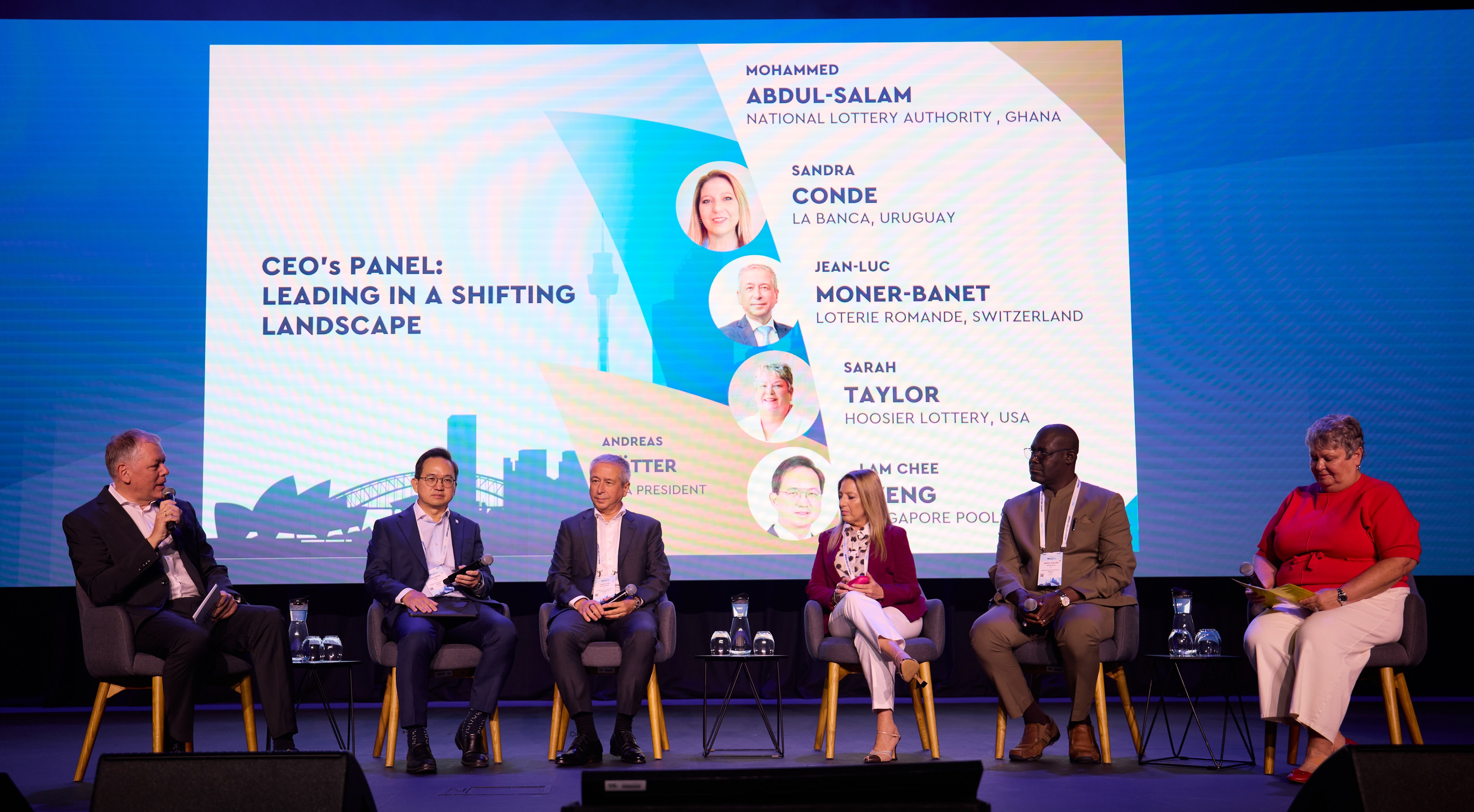
Discussing choices and next steps of what to protect, where to move, and how to achieve this together, Kötter was joined by panelists:
- Mohammed Abdul-Salam, Director-General, National Lottery Authority, Ghana
- Sandra Conde Gómez de Freitas, General Manager, Banca de Quinielas de Montevideo, Uruguay
- Lam Chee Weng, Chief ExecutiveOfficer, Singapore Pools, Singapore
- Jean-Luc Moner-Banet, DirectorGeneral, Loterie Romande, Switzerland
- Sarah M. Taylor, Executive Director, Hoosier Lottery, USA
Global perspectives
The environment in which lotteries operate has changed considerably in a short time. New competitors, products, and forms of legal and illegal gambling are challenging the place we have long held in our markets.
How does it look in each region?
Indiana, US
Sarah Taylor: There are a number of areas tohighlight. Consumer behaviour is changing the impact of retail sports betting. Some legislator are concern with advertising and prediction markets. Other issues to watch are emerging adults and the need for prevention education, as well as maintaining cybersecurity.
Ghana
Mohammed Abdul-Salam: There has been a shift from paper-based retail to mobile phone, using USSD (built-in GSM network communication protocol), which has eroded retail products in traditionally paper-based lotteries. The mobile option pays more or less instantly, to the mobile phone wallet, whereas paper can take days. We need to combat the illegals on mobile applications, and enforcement must go beyond borders, through networking and collaboration with other countries and authorities.
Uruguay
Sandra Conde: Some challenges we have are with digitalisation and being able to continually innovate products. Illegal online gambling, is another issue, despite our regulatory framework and measures to block sites and payments. Enforcement is too slow and illegals adapt quickly. We are aligned with the WLA position, however we need more contact with regulators.
Switzerland
Jean-Luc Moner-Banet: In Switzerland illegals don’t stop at the border. Prediction markets and online illegal operators impact our country and small population. It is part of our social duty to support the physical retailers, and to help digital retail by combatting illegal operators.
Singapore
Lam Chee Weng: In Singapore the problem of illegals was addressed by assessing the size of this market. We spoke with the regulators, met with police and shared an illegal site list. The authorities clamped down on these illicit activities and this enforcement has been successful.
The impact of technology and artificial intelligence
We live in a digital world. Technology is part of our industry. Lotteries and sports betting operators have always been early adopters of cutting-edge technologies.
Artificial intelligence is deployed across operations, product offers and services. AI can automate risk management, refine odds-setting, detect fraud and match fixing, personalize user experiences and assists operators in ensuring safe, responsible player environments.
Technology, and AI bring new opportunities, but they also power many of the competitors we have just discussed.
How are technology and AI changing the way your lottery operates and engages with players, and how are they reshaping the lottery sector as a whole?
Singapore
Lam Chee Weng: We must always be available for customers. Our operations behave as critical infrastructure, with very few hours of downtime annually. We achieve this with AI for monitoring 24/7 to detect any issues. In particular, generative AI creates greater efficiency for customers.
Switzerland
Jean-Luc Moner-Banet: Sports betting players are using AI to optimize their investments, and get better predictions for their gaming, which means that we have to counteract such activities. We also use AI to enhance detection of players, whose behaviour maybe evolving to become more at risk.
Uruguay
Sandra Conde: We defined and approved responsible use of AI to improve efficiency across operations. It's deployed for customer service, to develop new games, protect players by monitoring their behaviour, so we can react more effectively with timely messages to at risk players. It is used to detect suspicious activity, such as money laundering, and to support our compliance team.
Ghana
Mohammed Abdul-Salam: We work with partners to develop in-house technologies and to train our team, as well as to enhance player protection, and fraud detection, but we are in the early stages of using artificial intelligence.
Indiana, US
Sarah Taylor: We use AI across operations, for player analytics, games creation, and predictive maintenance for self service machines in the retail outlets.
Protecting state-authorized lotteries and sports betting operators
Under competitive pressure, it is tempting to change everything. But our legitimacy rests on principles that set us apart: integrity, transparency, player protection and our contribution to society. So, the question is what we must hold on to, and where we must have the courage to change.
What parts of the lottery model are non-negotiable, and where does the sector need to adapt to stay competitive?
Ghana
Mohammed Abdul-Salam: Growing funding for good causes means we must take measures to stop illegals who erode these funds. We need to invest in technology to achieve this. We have different authorities for sports betting and lotteries which creates openings for illegals who may not always be licensed to operate both, but do so anyway. We would like to see one authority for both, to close this loophole.
Uruguay
Sandra Conde: Player well-being is at the centre. Responsible gaming measures for what and how we offer games mustbe upheld and Level 4 Certification is a must for LaBanca. Public trust is vital, as well as evolving through continual innovation.
Switzerland
Jean-Luc Moner-Banet: It is essential to know what operations are legal and what are illegal, which applies wherever you are, whatever your product is called, whether a sports event on prediction markets, or sports betting. We must offer attractive and responsible products, and underscore the latter point, which makes us unique.
Singapore
Lam Chee Weng everything is non negotiable reputation, risk, integrity and always being available to customers. We must try to educate our regulators in order to stay relevant to customers.
Indiana, US
Sarah Taylor: Games of chance, responsible gaming, maintaining integrity, and public trust.
Moving with the times
Our industry is fast moving and impacted by many trends, but we must keep up with it. What do we need to change?
Singapore
Lam Chee Weng: We need to play our A-game which means being proactive and combatting illegals, and innovating products rapidly. We must maintain and grow our customer base, by enhancing our value proposition to them.
Switzerland
Jean-Luc Moner-Banet: Young people may say if sites are illegal, why are they accessible? We must improve the way we communicate with players and help them understand how society is negatively impacted when they play on illegal platforms.
Uruguay
Sandra Conde: I agree with Jean Luc, communication with young players and raising awareness of this issue of legal versus illegal operators is vital. We should use influencers from this generation to connect with them, in the channels that they use.
Ghana
Mohammed Abdul-Salam: We need to invest more in educating players and consumers on this point, so that they understand what their ticket money supports. We must tell these stories, to maintain industry integrity and public trust.
Indiana, US
Sarah Taylor: We must share our winner stories and ensure clear messaging on all fronts, with players and regulatorsalike.