

AML Compliance and how WLA supports its members
WLA members face many challenges when it comes to tackling illicit operators, who jeopardize the integrity of the regulated industry, and often operate at an advantage.
Some challenges include:
- Increasing technological and digital complexity of the sector, where rapid and sometimes anonymous transactions through crypto-assets and digital wallets, make it difficult to identify the true source of funds.
- The rise of offshore and unlicensed operators — often operating through so-called “white-label” structures — outside strict regulatory jurisdictions, allowing for anonymous betting activity that may involve organized crime.
- Growth of high-velocity betting, particularly live or in-play betting, which requires real-time monitoring capabilities to identify suspicious patterns and unusual activity.
- “Quick-in, quick-out” laundering methods, where individuals deposit funds, place minimal or low-risk bets, and rapidly withdraw funds, effectively using betting platforms as pass-through financial channels.
- Use of intermediaries or agents to manage accounts and conceal the true beneficial owner of funds.
- The close connection between illegal betting markets, corruption, and match-fixing activities.
- Increasingly complex and evolving regulatory frameworks, where operators active across multiple jurisdictions must navigate differing and sometimes conflicting standards.
- A lack of sufficient coordinated information-sharing mechanisms across the industry, which still allows suspicious or banned individuals to move from one operator to another.
Against this backdrop, one of the key point is to ensure the right balance between strong compliance requirements and maintaining an attractive, safe, and seamless experience for consumers within the regulated market.
WLA Betting Integrity for Sports and Horse Racing Committee
The World Lottery Association, Betting Integrity for Sports and Horse Racing Committee supports members in the areas of:
- Anti-money laundering
- Combating match-fixing
- Promoting sports and horse racingproducts in a competitive and socially responsible manner.
The Committee has developed the AML Best Practices Guide for Lottery and Sports Betting Operators, including an in-depth Swiss use case from Loterie Romande, and a practical guide to the Macolin Convention developed by the Council of Europe, on the Manipulation of Sports Competitions, explaining the Convention's benefits for the lottery, sports betting, and broader sports ecosystem.
It also collaborates extensively with global partners to raise awareness and strengthen cooperation on integrity and AML-related issues, including the:
- United Lotteries for Integrity inSports
- European Lotteries
- IOC Olympic Movement Unit on thePrevention of Competition Manipulation
- Council of Europe
- International Federation of HorseRacing Authorities.
Panel discussion on AML perspectives and approaches
WLA Executive Director, Luca Esposito, moderated a panel that built on presentations from Ola Carlsson, Head of Pools, AB Svenska Spel; Riccardo Taccia, Anti-Financial Crime International & Advisory Senior Manager, Sisal SpA, and Lucy Mullens, Executive Manager of Financial Crime Risk Investigations, Hong Kong Jockey Club, China.
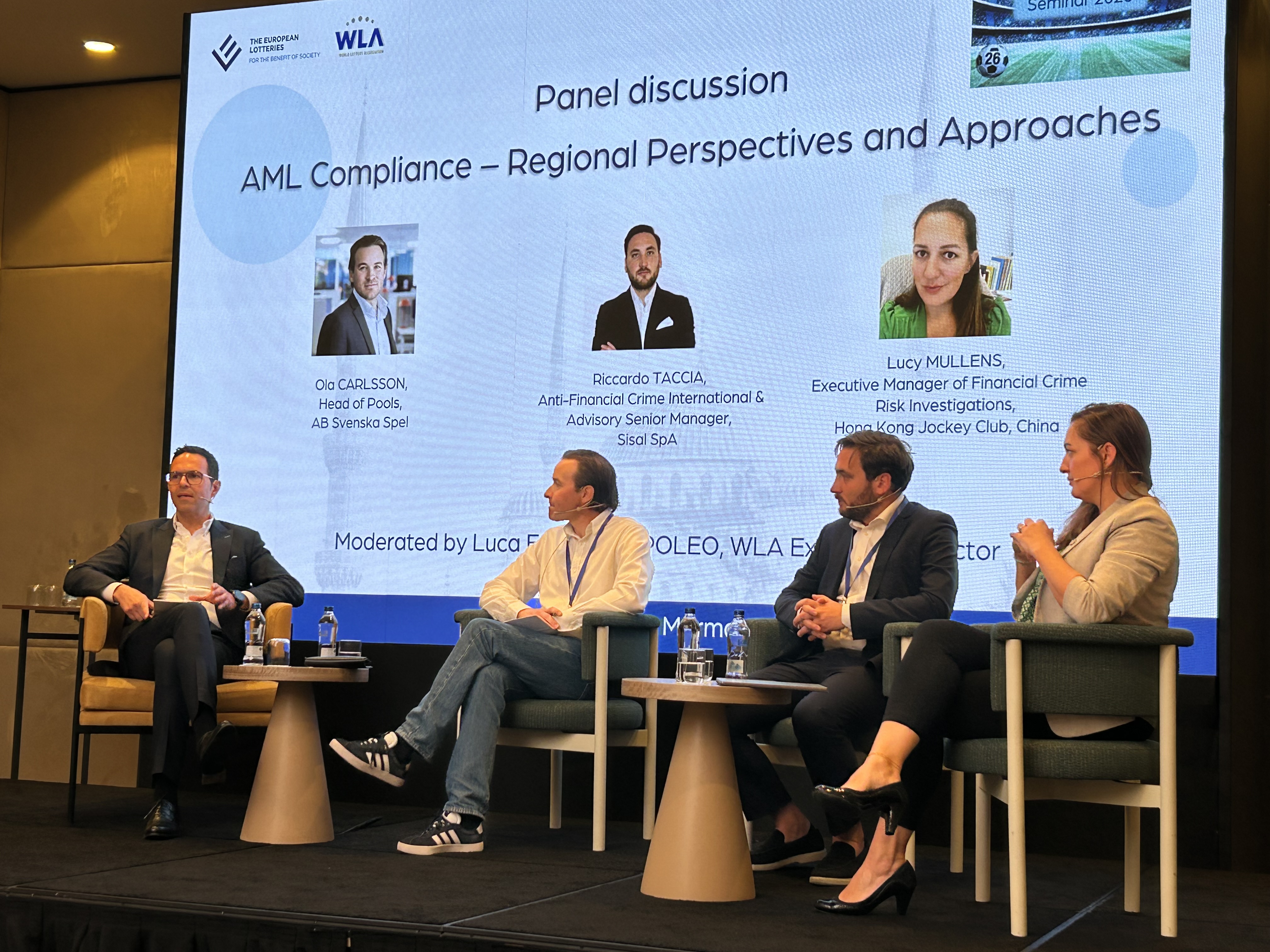
Carlsson discussed regulatory developments in Sweden, in particular, the introduction of mandatory registration from 2019 onwards and the clear benefits this has brought in terms of preventing money laundering, protecting minors, and strengthening oversight, even if it has had a negative impact on GGR.
Taccia described the significant regulatory evolution that has taken place in Italy over the past decade, as well as the strong focus on behavioural analysis, targeted controls, and end-to-end monitoring within the AML framework of the Italian gaming and lottery sector.
Mullens presented an overview of the Hong Kong model, where AML is addressed through close cooperation with the Home and Youth Affairs Bureau, the police, and the Independent Commission Against Corruption and where the regulatory framework is evolving to align with peer jurisdictions, such as the UK and Singapore.
It was noted that handling illegal markets is a complicated situation that requires all stakeholders (institutions, authorities and legal operators), and to find a balance to avoid the situation that implementing too many measures pushes consumers to other sites (including unregulated).
Education is key to understanding what is meant by legal operator, as well as the consequences of using non legal sites, which result in less safe environments for players, and less funds for good causes that positively impact society.