

Moderated by Beata Stelmach, Totalizator Sportowy, Poland, with panellists Harjinder Shergill Chima, Director,California Lottery, USA; Colin Smith, CEO, Lotterywest, Australia; and Moustapha Camara, Chairman, LONASE, Senegal, the discussion showed how lotteries in very different markets are making their impact visible to players, governments and communities.
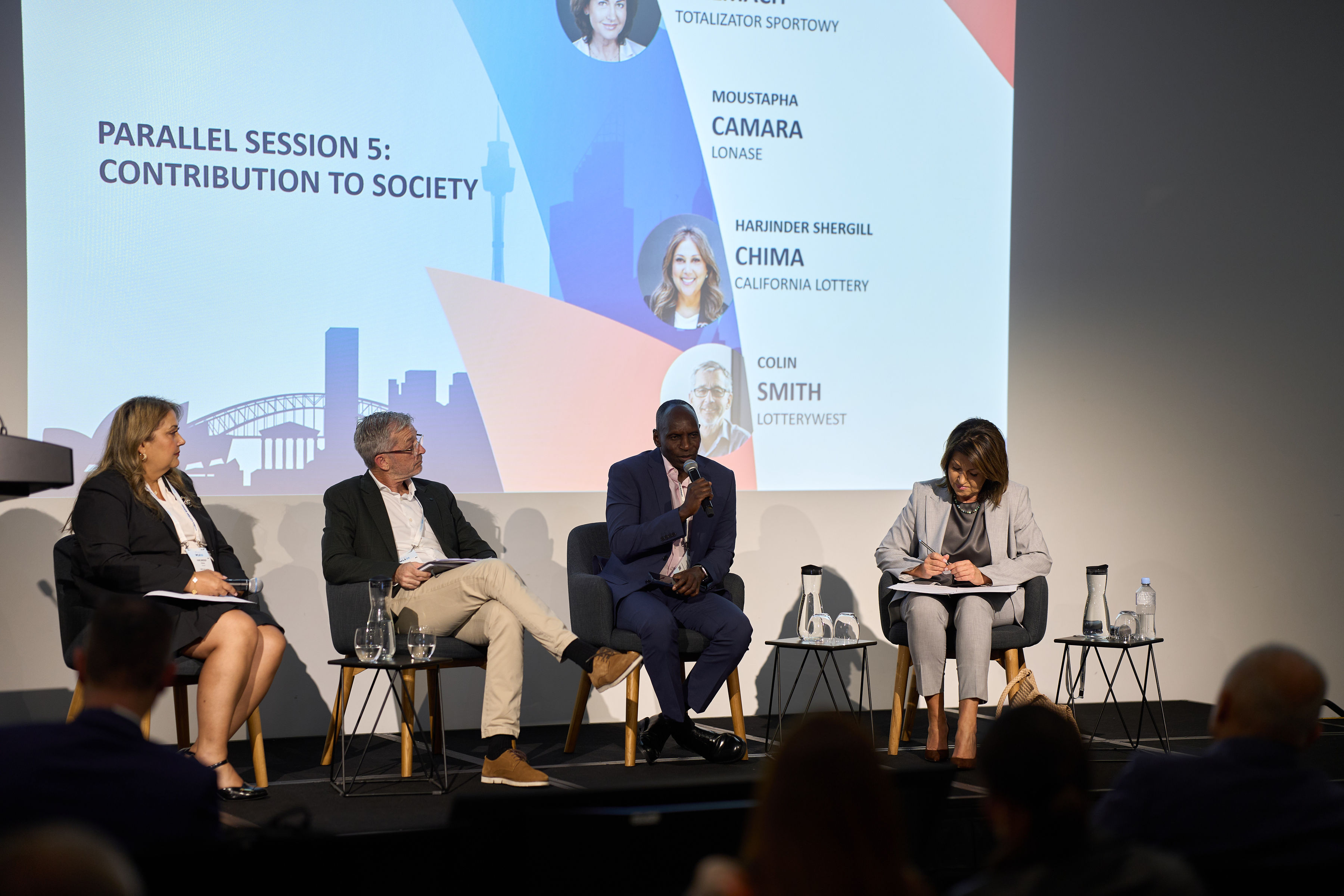
Stelmach opened the session by noting that while members operate in different regulatory environments, they increasingly face the same challenges. Digitalisation is transforming the industry, a young generation born in the digital era expects a different offer, and unlicensed and offshore operators are a growing threat. Lotteries cannot address this alone, she said, calling for closer cooperation with regulators, payment service providers, financial institutions and major digital platforms to limit the visibility, accessibility and financial infrastructure of illegal operators.
“Our role is not only to generate funds for good causes, but also to ensure that gambling takes place within a legal, transparent and responsible environment. As markets become increasingly digital, this responsibility becomes even more important.”
Below are some highlights.
California Lottery, US
Harjinder Shergill Chima explained how the California Lottery demonstrates the tangible value it delivers to its beneficiary, California’s public schools. Since its launch in 1985, the lottery has contributed over USD 52.2 billion, with USD 16 billion of that since 2018, and the four highest-funded years in its history all falling within the last eight years. Contributions average around USD 2 billion a year.
Research showed that many Californians did not know where the money went. In 2023, the lottery launched its You Play, Schools Win campaign, featuring real students, teachers and administrators. Developed through focus groups and outreach to more than 900 school districts, it has since highlighted over 53 programmes, using a multilingual approach aimed at millennials, Latino communities and Spanish-speaking Californians.
The results are clear. Awareness of the lottery’s education mission rose from 25% to 40% of adult Californians after the first year, and positive sentiment rose from 52% among those who had not seen the campaign to 68% among those who had. One video, written and directed by Sacramento State film student Kevin Wade Jr., shows how lottery-funded American Sign Language interpreters let him take full part in campus life. Earned media coverage of local stories has extended the campaign’s reach further.
“Don’t just tell people where the money goes. Show them whose lives are made better because of that lottery funding.”
Lotterywest, Australia
Colin Smith described Lotterywest as the only government-owned lottery operating in Australia, serving 2.6 million people across Western Australia’s 2.5 million square kilometres. Approaching its centenary, its vision is to connect people, possibility and purpose to create a better Western Australia, with all available profits returned to the community through grants and statutory funding.
Last year, Lotterywest generated AUD 1.3 billion in sales and AUD 760 million in prizes. It returned AUD 404 million to the community: AUD 172 million in discretionary grants to 452 organisations, and AUD 232 million to health, arts and sport through government programmes. Examples included cyclone recovery support, the Kimberley Land Council’s fire management work combining Indigenous knowledge with contemporary science across more than 4.8 million hectares of savannah, and Ruah’s centre in Perth supporting women and children affected by domestic violence.
Smith stressed that Lotterywest’s grant-making is built on listening, with a team of around 30 people working incommunities, and that its role now extends to convening government, philanthropy and community partners. Its 480 retailers remain the cornerstone of the business and a community meeting place, particularly in regional areas.
“Commercial success and social responsibility are not competing priorities.The stronger the trust placed in our organisation, the stronger our ability to deliver back to the community.”
LONASE, Senegal
Moustapha Camara described LONASE’s simple social contract, captured in its motto: fortune to the players, benefits to the nation. He outlined several ways the lottery creates impact beyond its direct contribution, including its role as a major partner of the Youth Olympic Games in Dakar, supporting infrastructure and national pride.
LONASE is also a major grass roots employer, with around 800 direct employees and some 5,000 people working through its network of agents, kiosks and local suppliers. Each of its roughly 5,000 points of sale across the country supports one or more families, a vital contribution where employment is the biggest priority.
LONASE’s financial contribution to the state is also growing. Through its foundation, LONASE also invests directly in health and education. It rebuilt and re-equipped the ear, nose and throat department at the Philippe-Maguilen-Senghor health centre in Yoff, Dakar. In October 2026, the foundation signed an agreement to build a socio-educational centre for young people in Mampatim, in the Kolda region.
Camara also highlighted the risk of problem gambling in Africa, where a very young, highly connected but economically vulnerable population is widely exposed through smartphones. In March 2026, LONASE signed a partnership agreement with CEPIAD, Dakar’s integrated addiction treatment centre, to strengthen the prevention and treatment of gambling addiction, train LONASE staff to refer players indifficulty, and fund research into gambling behaviour in Senegal.