The sixth parallel session at WLS 2026, Disruption– Trends: prediction markets and beyond, explored how lotteries should respond when new products challenge established rules.
The session was moderated by Andreas Kötter, President, World Lottery Association, with panellists:
- Mark Michalko, CEO, North Carolina Education Lottery, US
- Jean-Luc Moner-Banet, President, United Lotteries for Integrity in Sports (ULIS)
- Douglas Robinson, Executive Manager, International Federation of Horseracing Authorities (IFHA)
- Salih Ercan, Deputy Director General, Turkish National Lottery Administration
- Michael Wells, Director, Oregon Lottery, US
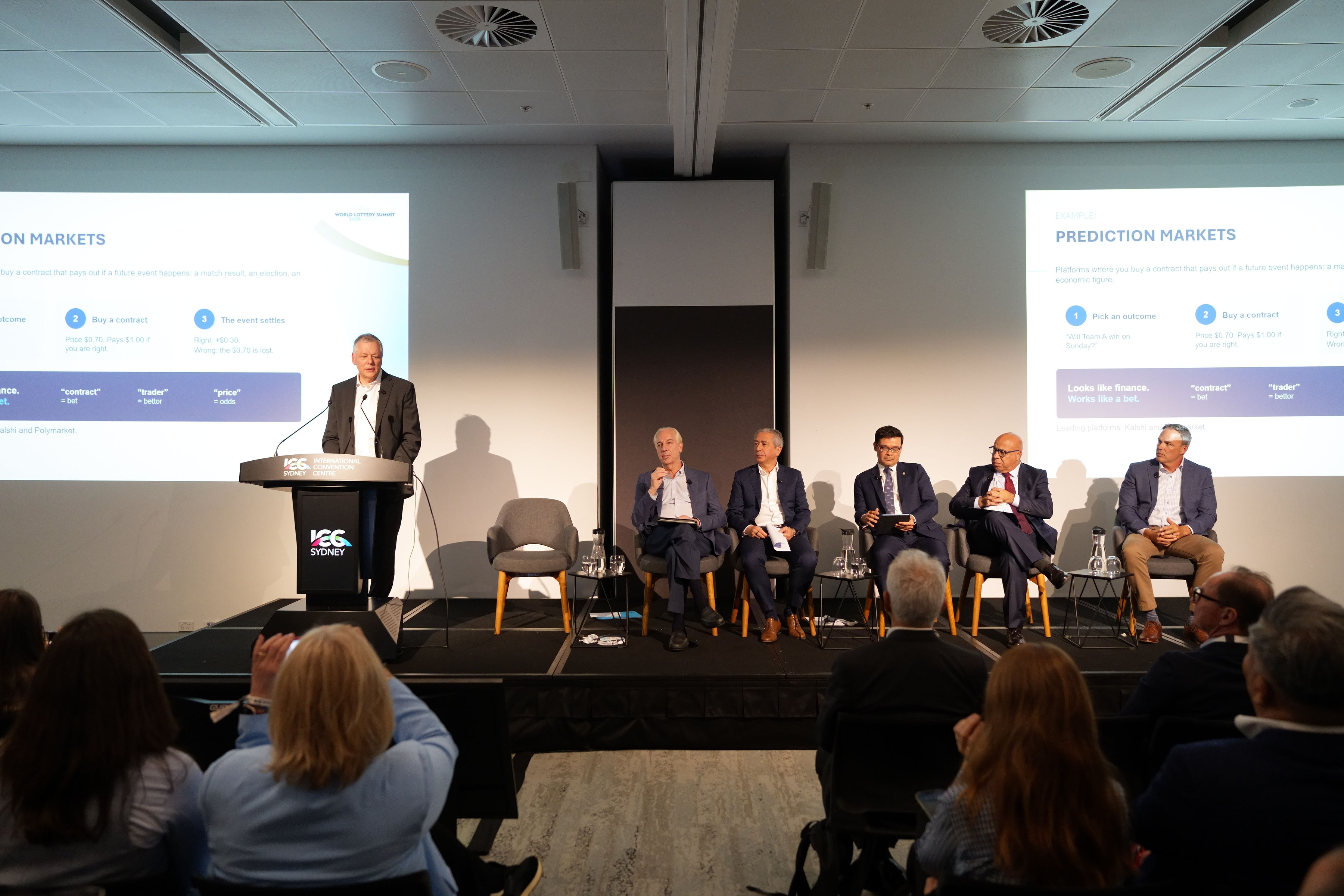
Prediction markets were at the forefront of the discussion and the panel was united: gambling and financial regulators need to align urgently to ensure prediction markets are subject to licensing, integrity, and player protection standards.
As Kötter noted in his opening remarks, these markets are appropriating the language of finance, while carrying risks of insider trading, manipulation, unclear settlement and no real player protection.
"It looks like finance, but in fact it's a bet."
North Carolina Education Lottery, US
Michalko, now in his 50th year in the gaming industry, called prediction markets "a watershed moment".
US lotteries started paying attention in February 2025, when Kalshi advertised event contracts on the Super Bowl. Within about 18 months, prediction markets went from being relatively unknown to operating in all 50 states. These well-financed companies offer contracts on everything from sport to the colour of the President's tie.
US states have historically regulated gaming, including sports betting. However, prediction market operators claim that event contracts are financial instruments regulated federally and therefore exempt from state gaming law.
The result is fragmentation. Federal courts indifferent districts have reached different decisions, and nothing will be settled until the US Supreme Court agrees to hear an appeal.
"Time actually favours the prediction markets, not lotteries."
The longer the uncertainty lasts, the more entrenched they become, and the average consumer does not distinguish between a state-regulated sportsbook and Kalshi or Polymarket.
When asked whether the wake-up call had come too late, Michalko said no, but lotteries must pay close attention and be ready to pool resources and speak with one voice once the courts give direction.
United Lotteries for Integrity in Sports
Moner-Banet asserted prediction markets are not new: betting exchanges have existed for years. But what has changed is the investment in product and marketing.
He focused on the risk of sports manipulation.
"Manipulation follows the incentive, not the product label."
Contracts on player performance, cards, corners and micro-events move the risk away from classic match-fixing towards spot-fixing and misuse of inside information. Some platforms even offer contracts on whether a player will miss a match through injury, which is far easier to manipulate than a final score.
ULIS detects manipulation through market data such as volumes and odds movements, account intelligence, sports information and human intelligence shared across its network. Although prediction markets operators are not ULIS members, ULIS monitors them using AI-powered tools. During the 2026 FIFA World Cup, the Group of Copenhagen coordinated monitoring of every match and included prediction markets for the first time.
He left delegates with three messages:
- A different label, or no regulation at all, does not change the activity: it is sports betting, with identical risks.
- Regulatory divergence creates integrity gaps.
- Equivalent activity requires equivalent safeguards, covering manipulation and all associated criminal activity.
International Federation of Horseracing Authorities
Robinson represented the IFHA's Council on Anti-Illegal Betting and Related Financial Crime. Its position mirrors the WLA's: prediction markets should be treated as betting, licensed as such and subject to the same customer safeguards.
Like Moner-Banet, Robinson noted this disruption isn’t entirely new. Racing has been here before when betting exchanges in the early 2000s created a heightened risk because they let people profit from a horse losing. That risk was mitigated through regulation and close monitoring.
Prediction markets are now recreating the exchange risk without the safeguards. Regulators need to "come off the fence" and regulate prediction markets for what they are, he said, and decide how to enforce against unlicensed entrants.
Turkish National Lottery Administration
Kötter introduced Türkiye as "one of the few success stories" on prediction markets. Ercan explained that the Turkish National Lottery Administration operates the non-cash lottery itself and regulates all lottery activity, after transferring the cash lottery licence to a private operator.
Under a one-year action plan against illegal gambling, the administration monitors illegal platforms and works with social media companies, the courts, the financial intelligence unit MASAK and the Information and Communication Technologies Authority (BTK), which blocks access.
After the WLA shared its position on prediction markets, the administration set up a team to assess the platforms. It first asked Türkiye's Capital Markets Board whether prediction market contracts were financial derivatives. The board said no: derivatives manage or transfer financial risk from changes in asset prices, while prediction markets trade on the outcomes of events.
An independent internal commission then assessed each platform. Most used cryptocurrency, which Türkiye's central bank does not allow as a payment instrument. None had a licence or a responsible gaming framework. The commission concluded they were unlicensed betting platforms, and access to Polymarket and Kalshi was blocked in July 2026. Ecran commented:
"In Türkiye, we say there is no regulatory gap. We have regulation for finance and regulation for gambling. We decide which it is, then apply the related regulation."
He called for clear regulatory frameworks, international information sharing, advanced monitoring technology and strong stakeholder engagement.
Oregon Lottery, US
Attention turned to a different kind of disruption: lottery courier services, which buy and scan tickets on players' behalf and resell them, often across borders. Oregon had no rules on couriers, and at its peak about two years ago, around 25 were operating there and selling worldwide.
When Wells became director, he realised "how unliked the Oregon Lottery was" internationally. But courier sales were amajor revenue source. The lottery is the state's second-largest source of revenue after income tax, and stopping international sales meant losing about 20% of draw-game revenue. Policymakers had no appetite for change.
The turning point came at WLS 2024 in Paris, where Wells had frank conversations with lotteries from around the world. Over the following year, Oregon received six letters from lotteries abroad, as well as from the WLA, explaining that the sales were potentially illegal and harming their players. "That made all the difference," he said. Oregon'spolicymakers did not want an international incident.
Because the Oregon Lottery is both operator and regulator, it did not need new legislation. It added a ban on international sales to its retailer contracts. The lottery has absorbed a loss of around 20% in draw-game revenue, Wells said, "but feels much better about the integrity of our lottery". His advice:
"If something is happening in your jurisdiction, go and find the person who is affecting it and have these conversations."
Kötter revealed that one of those letters came from his own regulator in North Rhine-Westphalia. It took a month to persuade the regulator to sign, and until the day before the session, he had not known it helped. He noted:
"Lotteries and sports betting operators have a strong voice. We can convince our regulators, and we can take action."