Moderated by Jason Delamore, CEO of Lotto New Zealand, panelists included Sandra Conde, General Manager, La Banca, Uruguay; Romana Girandon, President and CEO, Loterija Slovenije (Slovenia), and Harry Ashton, Group General Manager, Responsibility, Aristocrat Interactive.
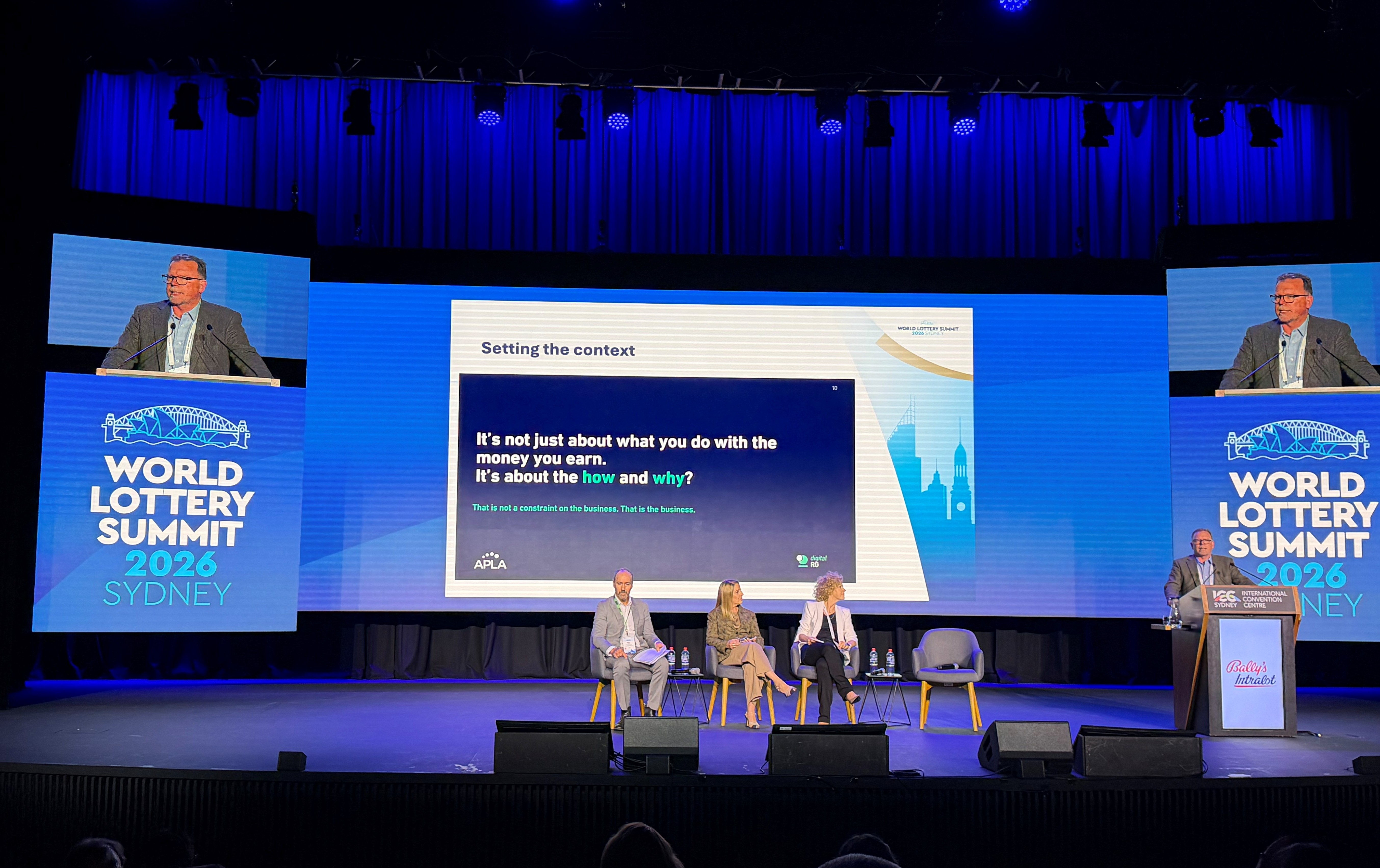
Delamore opened with the question: what does it mean to have good sustainability? He explained, it was not just about the environment; it was a bigger strategic question with diverse aspects.
The lottery and sports betting industry competes for customers in a market of younger, digital-savvy players, which requires constant innovation. As government regulation asks more of operators, they need to be more commercially capable and responsible. Those who manage both will achieve sustainability.
Below are insights from the panel.
Slovenia Lottery
Against the backdrop of the long history of lotteries in Europe for which the public benefit has always been the heart even before they came to be called lotteries, Girandon highlighted the importance of sustaining the industry, through earning public trust by protecting players, and the environment. Sshe noted that it was key to be able to demonstrate the work done to support good causes and positively impact society.
On this point, she commented on the European Lotteries (EL), for which she is President:
"The European Lotteries brings all its member's results, together on a European scale making our impact more visible and convincing."
Though Slovenia has a small population of around two million, Girandon noted that the commitment of the Lottery was big to give Slovenian players an experience that could stand alongside the best and biggest in Europe. This is acheived by building the culture around two equally important aspects: the ambition to achieve great results and commitment to the Lottery's purpose and values of public benefit, responsible gaming, integrity - leading by example, equal opportunities and respect for diversity.
"We reflect this in almost every conversation, every decision, achievement, event. We invest in our people and in the way we lead them."
EL helped the Slovenia Lottery to understand how important its mission is, and enabled the Lottery to discover the heritage of many European counterparts. It's report underscoring the funds given to good causes within Europe also demonstrates the work, its initiative through the EL Lottery Heritage task force to have UNESCO recognize lotteries for public good as part of Europe's Cultural Heritage are some of the ways to lottery sustainability can be used to enhance trust and legitimacy.
Girandon closed with a final thought:
"Keeping a New Year's resolution is objectively hard, but keeping an idea alive for almost 600 years is extraordinary and I am not talking about the 600 years already behind us, I am talking about the 600 years ahead."
LaBanca, Uruguay
LaBanca's sustainabiltiy strategy means from CSR to a sustainable business model, integrating sustainability into our business strategy means balancing organizational goals with the economic, social, and environmental impacts of our activities.
"Our purpose is to strengthen social legitimacy, ensure long-term business sustainability, and contribute to society's well-being."
This means balancing organizational goals with the economic, social, and environmental impacts of our activities. Ensuring long term sustainability involves strengthening trust and reputation, anticipating risk and adapting to change, integrating sustainability into decision making and driving innovation and continuous improvement.
This is achieved through Five Strategic Pillars:
- Responsible gaming and player protection - at the heart of the business and sustainability strategy, because the way games are designed, marketed and operated has a direct impact on people and society.
- Governance, Integrity and responsible innovation - include carbon footprint and energy efficiency initiatives, employee awareness training and waste management.
- People well being and development
- Environmental responsibility and circular economy
- Economic and social contribution
Sustainability creates long-term value. Resilience enables us to keep creating it in a changing world.
Sustainability also requires facing new competition, protecting social trust, embracing technology and creating lasting value.
Aristocrat Interactive
Presenting on empowering a sustainable future at Aristocrat, Ashton underscored the importance of sustainability governance, which is embedded in the Aristocrat 2030 Corporate Strategy, and built into enterpriserisk management, for risk identification, assessment and Board oversight, as well as being embedded in responsible gaming Board charters.
“We seek to uphold high standards of governance and responsibility, to positively impact our people, customers and communities.”
Four pillars address material topics, with empowering safer play at the centre. They cover regulation and compliance, business conduct and ethics, digital trust and cybersecurity, responsible gaming which comprises strategies and initiatives tailored to each player risk profile, and predictive analytics that reduces player risks over time. Other areas include operational sustainability such as circular economy and supply chain sustainability, as well as health and safety, and community impact.
Ashton explained the business case for sustainability and expectations from different stakeholders. Investors and employees expect industry leadership in environmental and social policy (ESP). Some customers expect leading ESP technology and low-emissions hardware, while some players expect a brand they can trust and a robust ESP program builds that trust. Finally, regulators and policymakers expect sustainability embedded in the business model, with mandatory requirements emerging.
“Meeting stakeholder expectations is central to the business case and supports Aristocrat’s social licence to operate.”