The eighth parallel session at WLS 2026, Security & Risk Management, looked at the most critical threats, security governance, the role of AI, and how to balance openness with control.
The session was moderated by Dato' Lawrence Lim, CEO, Magnum Corporation, Malaysia, with panellists:
- Alessandro Paciucci, SVP, Italy Lottery Operations, Brightstar Lottery, and Chair, WLA Security and Risk Management Committee
- Lucy Mullens, Executive Manager, Integrity and Financial Crime Risk Investigations, The Hong Kong Jockey Club
- Brett Toyne, Executive Director, Multi-State Lottery Association (MUSL), US
- Marcos Vinícius e Silva, National Superintendent for Risks, Compliance and Integrity, CAIXA Loterias, Brazil
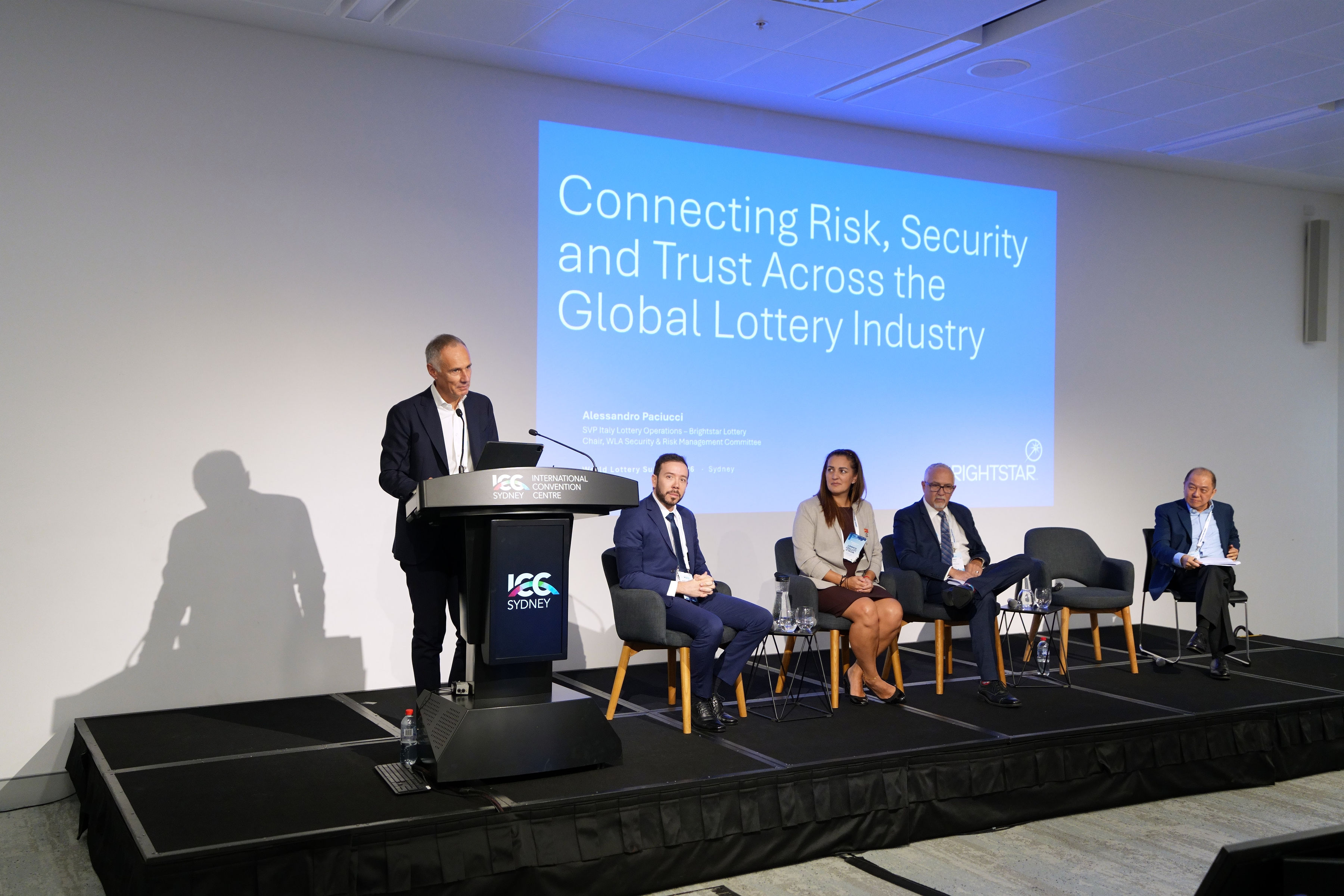
The key messages included: trust is a lottery's most valuable asset, security and integrity must evolve as fast as technology, and responsible growth requires robust governance that protects not only systems but also the people who play.
Brightstar Lottery and the WLA Security and Risk Management Committee
Paciucci said every lottery in the room operates under different markets, regulations and business models, but all depend on the same asset: trust. Twenty years ago, the industry's main concern was physical security. Today, attacks are more sophisticated, AI is changing the environment and supply chains are more complex, so an incident at one lottery can affect the reputation of the whole industry.
The Committee's mission is to turn standards into practical tools and guidance, monitor emerging technology and risks, keep the WLA Security Control Standard (WLA-SCS) up to date, and build a common risk culture across members. In the past two years, it has launched the 2024 WLA-SCS with a more risk-based approach. It’s expanded its risk register, with each risk setting out causes, impacts and mitigation measures, built a library of risk profiles, and delivered seminars across four continents.
Paciucci also shared Brightstar's experience in Italy, where it serves more than 20 million players, around 40% of the adult population. Its integrated approach links risks, controls, incidents and lessons learned in a single cycle. Over the past two years, this has moved key risks from the critical zone of its risk matrix into the controlled zone and cut the number of incidents.
"Risk management is often seen as a barrier to growing the business. Our experience shows the opposite. Trust is not free. It must be earned every single day."
The Hong Kong Jockey Club
Mullens, a former UK police officer who later worked in financial crime investigations in banking, leads the Hong Kong Jockey Club's investigations and financial crime teams. The Club is Hong Kong's only legal betting operator, offering football betting, the Mark Six lottery and horse racing, and returns its surplus to the community.
Mullens explained that defining the threat landscape starts with purpose and strategic priorities, which tell an organisation what its crown jewels are. From there, organisations must ask what hasn't changed (phishing, ransomware, extortion), what's new (AI-assisted social engineering, organisational complexity, illegal betting shifting to prediction markets), and what's next (supply-chain attacks and exploits that move "from days and weeks to minutes and seconds").
The Club uses a three lines of defence model:
- First line: a dedicated cybersecurity team, close relationships with law enforcement, approved devices only, and monitoring of unusual customer log-ins and connections
- Second line: regular cyber incident tabletop exercises across the business, including decisions made in advance about ransom demands; red, blue and purple teaming; monitoring for data leaving the network; takedowns of sites impersonating the Club; and phishing tests and an annual Cyber Awareness Month for staff
- Third line: committees and audit that "check the checkers"
When asked what the risk landscape would look like in three years, Mullens said that trying to predict it is guess work. Two years ago, prediction markets were not on anyone's radar.
"The important thing is how you protect yourself against the unknown. That means continuous risk assessment, external threat monitoring and incident plans that everyperson knows how to execute."
Multi-State Lottery Association
Toyne took a different angle, with a case study on how MUSL managed the risks of launching Powerball in the UK. He approached risk management by identifying what was unique to the collaboration and bringing in the right subject-matter experts.
The challenges were organisational, financial, security-related and legal. All 39 members of MUSL's board had to pass UK fit-and-proper checks. Currency and exchange-rate risks had to be managed. MUSL documented over several months that the UK National Lottery and its operator Allwyn met Powerball's minimum security standards. It also had to satisfy theUK regulator's robust approval process for new games. Regular meetings with finance, legal and other teams, overseen by a steering committee, kept the work on track.
The biggest risk was misappropriation of intellectual property. MUSL registered the Powerball trademark in the US in 1992 and in the EU in 2007. In 2014, a third party applied to cancel the EU mark for non-use, and the mark eventually passed to a company associated with Lottoland. After years of appeals, MUSL changed strategy and argued that the mark was being used in bad faith. In February 2022, the EU authorities found in MUSL's favour, and the decision was upheld on appeal. That meant Powerball could launch in the UK using both its name and its logo.
CAIXA Loterias, Brazil
Silva's central message was that sustainable growth requires security, integrity and responsible gaming to evolve together. CAIXA considers its most critical risks to be cyber attacks on digital channels, fraud and abuse, third-party exposure through partners and APIs, and operational resilience. What matters most, he said, is that these risks are interconnected: a cyber incident can enable fraud, a supplier failure can become a continuity crisis, and AI can amplify the speed and scale of all ofthem.
CAIXA also uses a three lines of defence model, but Silva stressed that structure alone is not enough. Technology provides controls; culture determines whether people recognise warning signs, raise concerns and act consistently under pressure.
AI, he said, is changing the risk landscape in two directions at once. It strengthens anomaly detection, transaction monitoring and control testing, but it also makes deception and social engineering more convincing and enables automated fraud.
"The question is not whether to use AI, but how to govern it. Governance is what makes innovation sustainable."
On openness versus control, CAIXA follows three principles: security by design, controls proportionate to risk, and continuous monitoring.