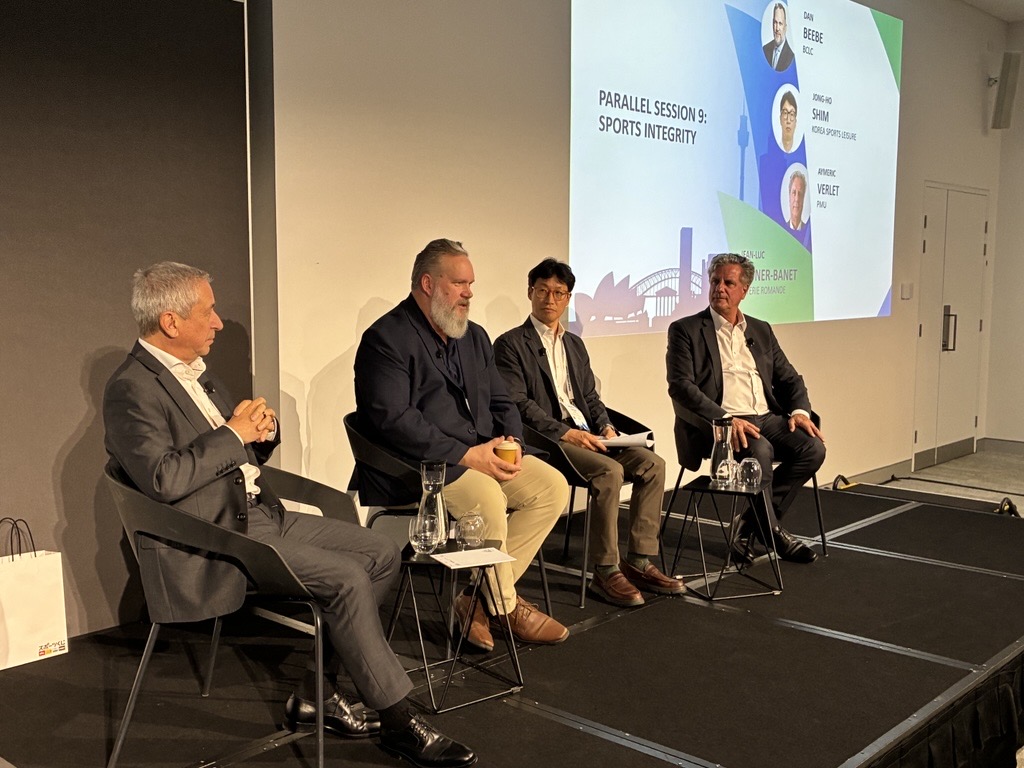
Moderated by Jean-Luc Moner-Banet, Loterie Romande, Switzerland, with panellists Dan Beebe, British Columbia Lottery Corporation (BCLC), Canada; Jong-Ho Shim, Korea Sports Leisure, South Korea; and Aymeric Verlet, PMU, France, the session presented three markets across three continents.
Moner-Banet opened by reminding the audience that every lottery offers products whose value depends on results being genuine, fair and transparent. Preserving that trust, he said, is the most demanding responsibility the sector carried, and the one that most directly determines whether it will still have a business in 20 years.
Alongside familiar threats such as underage gambling, addiction and money laundering, he pointed to the rapid growth of illegal operators, prediction markets operating outside licensing frameworks, increasingly sophisticated international criminal networks, and fast-moving AI. Individual monitoring systems only work, he argued, when operators, sports bodies and authorities share reliable information, which is why the United Lotteries for Integrity in Sports (ULIS) was built as an ecosystem spanning education, monitoring, detection, reporting and collaboration.
He also urged members to promote the Council of Europe's Macolin Convention to their governments and regulators. It remains the only instrument giving cross-border cooperation a legal foundation, and recent signatories include non-European countries such as Brazil, Mexico and Australia.
Below are some highlights from the panellists.
BCLC, Canada
Dan Beebe outlined BCLC's four integrity priorities: rapid detection of suspicious activity, response, intelligence sharing, and adapting to emerging threats. ULIS alerts on unusual odds movements are checked against BCLC's own player base, and the sports betting team will pause a market on an alert without waiting for validation. Void bet reports help identify hot spots among its 3,500 retail locations.
BCLC shares intelligence instantly with Canada's other regional lottery organisations and regulators. Beebe cited a suspected fixed UFC fight where two partners closed their markets and BCLC did not, applauding both approaches: “There is nothing wrong with being careful.”
He flagged fake leagues, such as three-a-side football staged in warehouses to facilitate illegal wagering and money laundering, and advertising from Ontario's open market drawing British Columbians to sites not legal in the province. In summarizing he commented:
"Enforcement currently falls mostly on operators. Keep integrity at the core, share intelligence with ULIS members and non-members alike, adapt controls such as IP blocking and VPN detection, speak frankly about illegal betting, and advocate for coordinated enforcement."
Korea Sports Leisure, South Korea
Jong-Ho Shim described South Korea as one of the world's most tightly regulated sports betting markets. Stakes are capped at 100,000 won (about USD 75) per person per program, with around three programs a week. Retail accounts for about 80% of sales and online 20%, and the payout rate of around 65% remains well below illegal competitors.
A major match-fixing scandal between 2011 and 2013, involving football, baseball, basketball and volleyball, shook public trust. Around 100 people were involved and some 50 players were indicted and banned for life.
In response, Korea Sports Leisure introduced an early warning system combining its own sales thresholds with ULIS green, yellow and red alerts, escalating serious cases to sports organisers and law enforcement. A real-time retail control system detects purchase limit breaches and prohibited remote sales via messaging apps, automatically blocking a shop for 24 hours in severe cases, supported by mystery shopping and retailer training. Further safeguards include education for athletes and officials, a betting ban for registered sports personnel, and a match-fixing reporting centre.
There has been no major match-fixing sandal in domestic leagues since, though Shim noted spot-fixing linked to illegal sites remains a threat. The government is also using AI to detect illegal websites, blocking related accounts and raising penalties for illegal operators and users.
PMU, France
Aymeric Verlet explained that more than 80% of French racing's funding came from betting, supporting an industry that employs around 120,000 people. As a not-for-profit operator, PMU returns its profits to racing and works with more than 120 partners in some 50 countries, around 20 of them WLA lotteries.
Integrity is overseen by three ministries and supported by the ANJ (French gambling authority), the financial intelligence unit Tracfin, and a dedicated racing and gaming police service. Internally, an independent compliance team reports to the board, central systems can cut suspicious retail transactions remotely, and staff complete annual training. Cash bets are capped at €1,000, credit betting is a criminal offence, and partners undergo AML and anti-corruption audits every two years. PMU has ended at least 10 partnerships on AML grounds.
Since 2022, the ANJ has been able to block illegal websites directly, closing around 1,300. It also moved against prediction markets, fully blocking Polymarket in France in 2026 after recording around 600,000 French connections in a single month. Verlet added that animal welfare is central to racing's integrity, with medication banned and around 29,000 tests carried out each year.
Across all three markets, the panellists agreed that integrity is the foundation of a licensed operator's right to exist, and that the most effective defence is operators, regulators and sports bodies working together internationally.