
Tomorrow in mind: Responsible gaming insights for the next generation

For decades, instant scratch games – scratchers, scratch-offs or scratchcards depending on where you are in the world – have powered lottery revenues. In 2024, the product category represented USD 111.5 billion in global retail sales. Behind the retail counter, however, little has changed with lottery. While modern retail systems track everything from soft drinks to shelf-stocking patterns, lottery scratch game retailers have often relied on handwritten shift reports, manual restocks and little insight into what sells, when and why. Open product displays aren’t necessarily secure, inviting theft from store employees and customers.
Responsible gaming is a core part of Scientific Games’ global business. With the future in mind, we made a bold move to incorporate responsible gaming into the broader scope of corporate responsibility led by our Global Legal and Public Policy team. This reflects our belief that responsible gaming is not a standalone initiative – it’s an integral part of how we operate worldwide. Embedding these principles across our business functions ensures that every decision, from product development to technology design, reflects our commitment to integrity and player well-being.
Our goal is to help lotteries make evidence-based decisions that protect players and sustain the future of play.
Embedding responsibility through collaboration
Our Responsible Gaming team collaborates broadly across Scientific Games global operations, engaging experts in data analytics, game design, marketing, player engagement and other core functions. Together, we ensure that responsible gaming principles are considered at every level of decision-making, across all products. This cross-functional approach is strengthened by partnerships with regulators, researchers and industry peers, ensuring alignment with emerging insights and global best practices. Together, we apply evidence-based strategies to foster safe, sustainable and enjoyable play experiences.
A research program built for insight and accountability
At the heart of our approach is the Scientific Games Annual Responsible Gaming Research Study, an independent, data-driven program that grounds our policies and initiatives.
Launched in 2021 in partnership with Simon Jaworski, Founder & CEO of Lotto Research, the study was designed to capture the evolving habits, perceptions and motivations of players while helping lotteries make informed, forward-looking decisions. Using consistent measures year after year, the study provides a longitudinal view of player attitudes and behaviors and has become one of the most comprehensive research efforts of its kind in the industry.
Each year, the Scientific Games Annual Responsible Gaming Research Study surveys over 3,000 U.S. adults through national and state-level samples balanced by age, gender, ethnicity, income and region. By the end of 2025, 16 participating U.S. state lotteries will have participated, along with a customized study for Lotto New Zealand – demonstrating the model’s global scalability.
Respondents are categorized into seven player groups, ranging from non-players to high-risk players, enabling lotteries to segment and understand behaviors, motivations and risk levels within their markets. This segmentation also enables lotteries to deliver specific messaging on responsible play to the right audiences. Participating lotteries also receive customized reports benchmarking their results against national trends. This transparency helps lotteries evaluate their programs, demonstrate accountability and refine their responsible gaming strategies with data-driven precision.
The state of play: 2024 insights

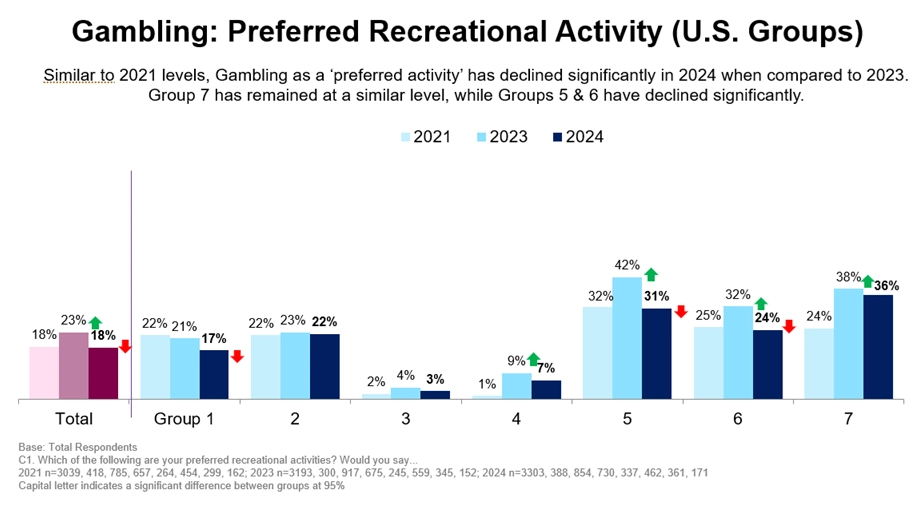
The 2024 study revealed a snapshot of several important trends. Participation in gambling activities softened slightly, with 73% of adults reporting that they gambled, down from 78% in 2023. Fewer players are citing gambling as one of their preferred recreational activities, returning to 2021 levels. At the same time, participants reported an improvement in their well-being, noting that they felt happier, less stressed and more financially secure than in previous years.
Meanwhile, 27% of participants expressed a desire to seek help for problem gambling, up from 23% in 2023. Encouragingly, the proportion who sought support remained steady at 61%, suggesting reduced stigma and growing awareness – a positive development for the industry.
The majority of players remain in the low-risk category, which is critical for maintaining the long-term health of the lottery ecosystem. Casual and low-risk players accounted for 38% of respondents, consistent with 2023 figures, while non-players held steady at 22%.
Emerging risk players, however, increased from 8% to 10% – a shift largely driven by younger adults aged 18 to 24.
Understanding this group is critical, as they represent the entry point for the next generation of players and a key focus for prevention and literacy efforts.
Moderate-risk players declined from 18% in 2023 to 14% in 2024, while higher-risk and problem-gambling groups remained steady.
The next generation of players
Young adults aged 18 to 24 are shaping the future of play. Digital-first and mobile-centered, they have grown up in a world of online entertainment, social gaming and instant access. In 2024, 63% of this age group played video games as a preferred activity and had already been exposed to forms of gambling such as loot boxes and purchasing coins to open packs and upgrades online.
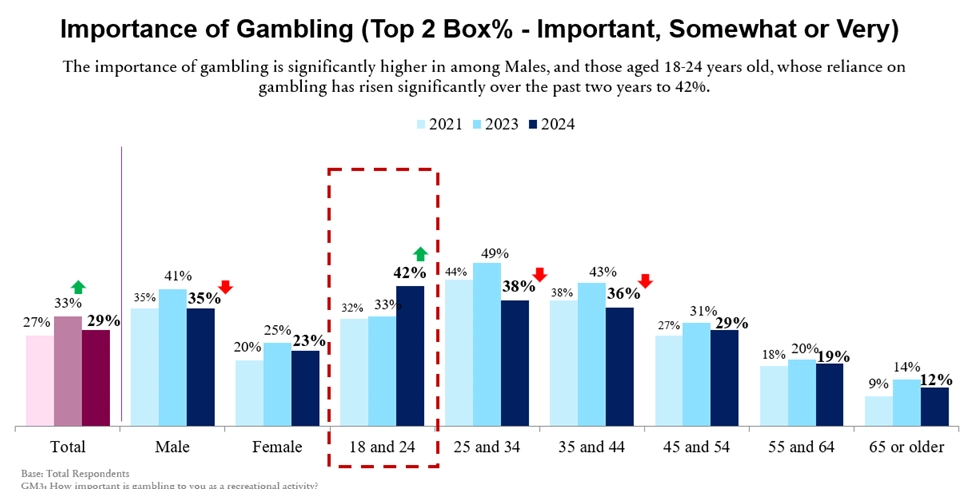
For this demographic, gambling occupies a notable place in the recreational mix, with 42% saying it is an important part of their entertainment life, a proportion higher than any other age group.
However, these players also have rising expectations. They value transparency, fairness and responsibility, and they want tools that empower them to manage play responsibly. With early perceptions shaping lifelong habits, the industry has a unique opportunity to earn their trust.
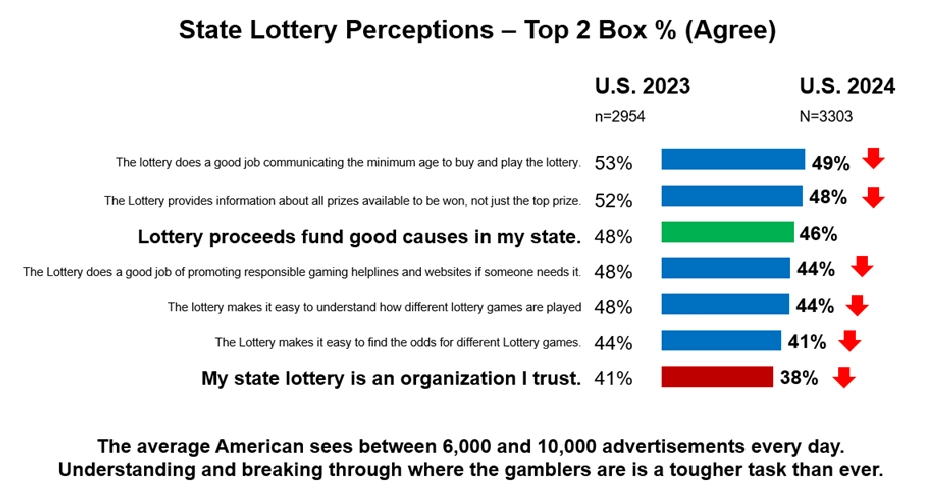
At the same time, with the average American exposed to 6,000–10,000 ads daily, breaking through with authentic, responsible messaging is increasingly challenging. Building trust is essential, especially as research indicates that confidence in the fairness of the lottery is declining. Reversing that trend is vital for the long-term sustainability of the industry.
A global lens for local impact
While much of our current work focuses on the U.S., the model and findings resonate globally. The success of the New Zealand study underscores its adaptability to other markets.
Participating lotteries gain the ability to compare player behavior with other similar jurisdictions, track emerging trends and benchmark their responsible gaming performance over time. This shared data fosters international collaboration, enabling lotteries to learn from one another, refine interventions and collectively advance player protection standards worldwide.
Building trust for tomorrow
The findings of our research reinforce a simple truth: responsible gaming is not about restriction, it is about understanding. By equipping lotteries with meaningful insights into how and why people play, we can develop strategies that support both player enjoyment and player safety.
The next generation of players expects the industry to lead with transparency, accountability and empathy. As responsible gaming evolves, Scientific Games, along with our lottery partners, remains committed to creating tools, education and experiences that allow players to Play Healthy – today and for generations to come.

Health Play® is a registered trademark of Scientific Games. © 2025 Scientific Games, LLC. All Rights Reserved.
About
Media inquiries
Legal notice


PLATINUM Contributors



Gold Contributors


The views expressed in the WLA magazine are those of the authors and do not necessarily reflect the views of the WorldLottery Association.

This pop-up contains legal information about this website.
This content is the property of the World Lottery Association (WLA). It may not be transferred
from the custody or control of the WLA except as authorized in writing by an officer of the WLA.
Neither this document, nor the information it contains, may be used, transferred, reproduced,
published, or disclosed, in whole or in part, either directly or indirectly, except as expressly
authorized by an officer of the WLA, pursuant to written agreement.
The WLA Website has been designed to provide information to the lottery community. The World Lottery Association has used great efforts to provide accurate and up-to-date information. However, WLA excludes any warranty, whether express or implied, for any information provided under these pages. WLA cannot be held responsible for any action taken that is based on the information hereunder.
The WLA Website also contains third party information. Such information is, wherever practically possible, marked with the name of the source and does not necessarily represent the opinion of the World Lottery Association. WLA does not take any responsibility whatsoever for such third party information.
The WLA Website also contains links to other Internet sites. WLA does not have any knowledge of the information contained in such other sites, nor has WLA been able to include such other sites in its efforts to provide accurate information. WLA therefore does not take any responsibility whatsoever for such third party information.
All rights reserved except where indicated.
