
Position Paper
Prediction Markets
Unlicensed Betting by Another Name — Threats to Sports Integrity, Consumer Protection, and the Lottery and Betting Sector
Greater regulatory alignment between gaming and financial market authorities is needed
Contents
Executive Summary
The World Lottery Association (WLA) issues this position paper in response to the rapid and largely unregulated expansion of prediction markets. The paper incorporates the perspectives of United Lotteries for Integrity in Sports (ULIS) on matters relating to sports integrity. WLA addresses the central challenge prediction markets pose to regulated lotteries, licensed betting operators, and the integrity of sport worldwide.
The scale of this expansion is significant. Global prediction market transaction volumes grew from under USD 100 million per month in early 2024 to more[ than USD 13 billion per month by late 2025, reaching USD 26 billion in January 2026 alone. An estimated 90% or more of current volume is driven by sports and other event contracts. Forecasts suggest the sector could reach annual trading volumes of USD 1 trillion or more by 2030.
This growth has been fueled by deliberate regulatory arbitrage. Prediction market operators describe their products using financial terminology, referring to wagers as “contracts” and participants as “traders.” This framing may contribute to positioning these products outside existing regulatory regimes applicable to lotteries and sports betting, including licensing, consumer protection, and sports integrity requirements. Terminology can influence how such activities are perceived and regulated. However, that rebranding does not change the underlying product.
The WLA opposes the unregulated and unlicensed operation of prediction markets and calls upon regulators, governments, sports bodies, and industry stakeholders to act on four urgent concerns:
- Unlicensed operation: Prediction markets offering sport-event and lottery-based contracts without a proper local license, operate in breach of applicable gaming licensing requirements and, internationally, outside the framework established by the Macolin Convention on the Manipulation of Sports Competitions that also is the basis for the definition of illegal activities in the lottery sector.
- Sports integrity and match-fixing risks: The absence of monitoring, suspicious transaction reporting, and insider trading prohibitions creates a direct route for corrupt actors to monetise manipulated outcomes.
- Consumer and player protection failures: in contrast to licensed lottery and betting operators, prediction market platforms are not subject to regulatory requirements on player protection, such as age verification, self-exclusion mechanisms, spending limits, or the provision of responsible gambling support.
- Regulatory gaps and unlevel competition: Licensed operators bear the full cost of compliance, taxation, and public good contributions. Unregulated prediction market operators bear none of these costs while competing for the same customers.
A predictable objection from the U.S. Commodity Futures Trading Commission (CFTC)-authorised prediction market operators is that they are already regulated. This paper addresses that argument directly: authorisation under a financial or derivatives framework is not equivalent to a gambling licence. CFTC designation as a Designated Contract Market does not impose age verification, self-exclusion, responsible gambling limits, suspicious transaction reporting to sports integrity bodies, or AML obligations calibrated to gambling risk. The same safeguards that apply to every licensed lottery and sports betting operator — licensing, age verification, self-exclusion, AML and counter-terrorist financing controls, suspicious-transaction reporting, and responsible-play limits — must apply to any product offering a financial return contingent on the outcome of an event, regardless of the legal framework under which it is authorised. Financial regulation and gambling regulation serve different public-interest purposes; where a product engages both, both sets of safeguards must apply.
The WLA calls for urgent alignment between gaming and financial market regulators to close regulatory gaps and ensure prediction markets are subject to the same licensing, integrity, return to society and consumer protection standards as betting.
The WLA calls for a functional, substance-based regulatory test: any product that offers a financial return contingent on a sporting or event outcome is a bet, and must be regulated accordingly, whatever label the operator chooses to attach to it.
The WLA therefore calls on gambling regulators to explicitly assess and determine the legal qualification of prediction market products, to avoid regulatory gaps and ensure that functionally equivalent activities are subject to equivalent regulatory requirements.
Where a jurisdiction chooses to classify such offerings as financial products, it should nonetheless require the application of safeguards and constraints equivalent to those applicable to gambling, given the comparable consumer-protection, integrity and harm-prevention risks involved.
1. Introduction
Prediction markets are platforms where participants purchase and trade contracts whose value is determined by the outcome of a future event. Any platform that offers a financial return contingent on a sporting outcome is, without being properly authorized to do so, operating a sports betting product. It requires a licence under applicable gambling law in every jurisdiction where it accepts customers. The same would be true with the prediction of results from Casino Games or Lottery draws.
The WLA is the global industry association representing state-authorised and licensed lottery operators across more than 160 jurisdictions worldwide. In preparing this paper, the WLA has drawn on the expertise of ULIS — the international organisation dedicated to protecting the integrity of sport from illegal and unregulated betting — particularly in relation to the match-fixing, insider trading, and sports manipulation risks that prediction markets create.
The WLA issues this paper because the prediction market sector has reached a scale and a level of mainstream penetration that demands a clear, principled response from the regulated industry. The sector’s own research acknowledges that its growth has been built on deliberate regulatory ambiguity — exploiting the gap between how gambling and financial regulation define their respective perimeters.1 That gap needs to be closed. The integrity of sport, the protection of consumers, and the sustainability of the regulated lottery sector all depend on it.
2. Prediction Markets: Context
2.1 Definition and background
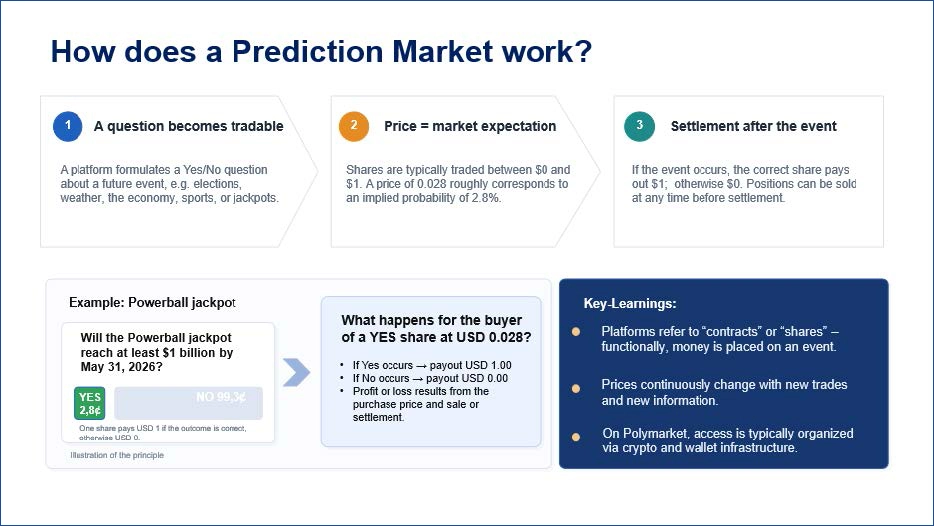
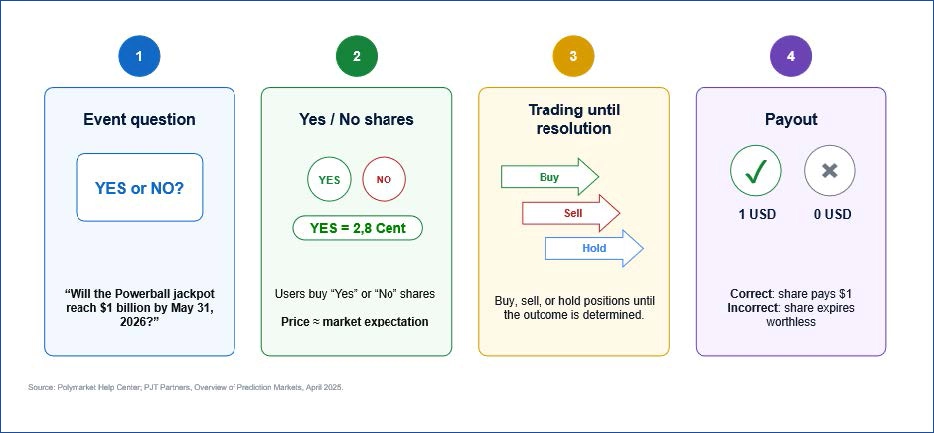
U.S. federal authorities define prediction markets as exchange platforms that specialize in offering event contracts. Event contracts refer to contracts with a binary payoff structure tied to the occurrence or non-occurrence of a specific event.
Prediction markets operate with prices reflecting the market’s collective assessment of the probability of an outcome. Participants trade peer-to-peer, operators do not assume outcome risk, and revenues are generated through transaction fees. Functionally, these platforms closely resemble betting exchanges, including the ability to take positions on losing outcomes, which raises comparable integrity risks eg in sports or political influenced events.
Prediction markets originated in academic research in the late 1980s, notably with the Iowa Electronic Markets, which used event-based contracts to study collective forecasting. In the early 2000s, commercial prediction markets emerged, most prominently Intrade, which gained visibility during U.S. election cycles before closing in 2013 following regulatory action by the U.S. Commodity Futures Trading Commission (CFTC). Since then, the CFTC has shifted to issuing guidance and initiating rulemaking aimed at clarifying how prediction markets and event contracts are regulated under U.S. federal law. Subsequent platforms sought to revive similar models, including sports-focused offerings presented as skill-based or financial products rather than gambling. In parallel, regulated peer-to-peer betting models were developed within licensed gambling markets, allowing users to trade directly on sports outcomes.2 Although prediction markets and peer-to-peer betting models evolved under different regulatory frameworks, they are operationally very similar, differing largely in legal classification rather than functionality.
More recently, large-scale prediction market platforms such as Polymarket and Kalshi significantly expanded the availability of event contracts on sports, operating under derivatives-based regulatory frameworks in the United States. This expansion was followed by the entry of major licensed sports betting operators, including FanDuel and DraftKings, which launched or announced prediction-market products, marking a convergence between prediction markets and the regulated sports betting sector.
2.2 Development
In recent years, a significant segment of prediction markets has developed on blockchain-based infrastructures, with platforms using smart contracts and cryptocurrencies to issue, trade and settle event contracts.
Major platforms such as Polymarket operate entirely on public blockchains and rely on crypto-asset settlement mechanisms, enabling global participation without reliance on traditional payment systems. Academic literature increasingly refers to these platforms as decentralised prediction markets, analysing their operation as part of the broader decentralised finance (DeFi) ecosystem.
The decentralised architecture of these platforms poses particular challenges for regulatory enforcement. Unlike traditional online gambling operators, which can be addressed through payment blocking, licence revocation, or action against a corporate entity, decentralised platforms have no central point of control. Smart contracts execute automatically on public blockchains without any single operator capable of implementing geo-restrictions, identity verification, or transaction monitoring. Regulatory actions such as Internet Services Provider (ISP) level domain blocking — while necessary — are inherently limited: users can circumvent them through virtual private networks (VPNs), alternative domain access, or direct blockchain interaction. Experience in Singapore and other jurisdictions that have moved to block access to Polymarket confirms that blocking reduces but does not eliminate activity. Following Singapore’s blocking order, the platform continued to attract wagers linked to Singapore-specific events, including local sports, electoral outcomes, and public data releases3. This limitation underscores that technical enforcement measures must be complemented by broader regulatory, financial, and international cooperation tools.
In the United States, the growth of prediction market platforms has been supported by federal regulatory developments, with some platforms authorised by the CFTC to offer event contracts as derivatives. This has created increasing tension with gambling regulation and sports integrity frameworks, highlighting the need for clarity regarding the legal qualification of prediction markets and their treatment under gambling law.
From a functional perspective, lottery draws are compatible with prediction market structures. Lottery results are objectively verifiable, time-bound events with clearly defined outcomes, and therefore meet the core criteria of event contracts. In this context, their inclusion would represent a natural extension of existing prediction market offerings, rather than a qualitative change in product design.
The same reasoning could apply beyond lotteries to other games of chance, including certain casino-type outcomes, where results are equally random and objectively determinable.
By replicating lottery-type products outside existing gambling frameworks, prediction markets would directly undermine lottery monopolies and divert player spend away from regulated lottery channels. This would result in a redirection of revenues from public-interest causes and good causes supported by lotteries toward private, often offshore commercial interests, while reintroducing the full range of risks already identified in relation to consumer protection, responsible gambling, and integrity.
The financial stakes for WLA members and the public-interest causes they fund are material and immediate. In FY 2024, the global regulated lottery and sports betting ecosystem returned USD 109.0 billion in support of good causes — funding health, education, sports development, culture, and social welfare — breaking the USD 100 billion barrier for the second time.4 Licensed lottery operators in jurisdictions where sports betting is also permitted generate significant additional revenue through regulated betting channels. Even a modest diversion of lottery and sports betting player spend to unregulated prediction market platforms would produce a measurable reduction in public-good contributions. To illustrate the exposure: if prediction market platforms capturing lottery-equivalent contracts were to attract just 5% of the regulated lottery sector’s annual global gross gaming revenue — a conservative figure given current growth trajectories — the annual diversion from public-benefit causes would exceed USD 2 billion. Unlike regulated lottery operators, prediction market platforms return nothing to society in exchange for the revenue they extract.
3. The Prediction Market Landscape: Scale and Key Actors
3.1 Explosive Growth
The growth of prediction markets between 2024 and 2026 has been extraordinary by any measure. According to data compiled by industry analysts, the sector has expanded as follows:
Sources: NEXT.io / Blask Index data; Eilers & Krejcik Gaming; Citizens Financial Group; Keyrock/Dune.
These figures represent the broader prediction market sector including non-sports contracts.
This growth has been driven primarily by sports contracts, which account for the vast majority of volume, alongside the US 2024 election cycle and retail brokerage distribution through platforms such as Robinhood. The Blask Index — a share-of-search-based demand indicator — recorded nearly fivefold growth in prediction market interest between January 2025 and January 2026 in the United States alone.
Prediction markets are not a niche experiment. In the US5, prediction markets have achieved 81% awareness among 18–20-year-olds and 49% brand recognition for Kalshi among 25–34 year-olds — the precise demographic cohorts the lottery industry depends on to renew its player base.
3.2 Key Operators
The US market is dominated by a small number of major platforms. Kalshi, founded in 2018 and approved in 2020 as the first CFTC-regulated Designated Contract Market (DCM) for event contracts, has leveraged its regulatory status as a core competitive advantage. Kalshi recorded approximately $22.9 billion in trading volume in 2025, generating an estimated $260 million in fee revenue for the full year. By late 2025, the company told investors it was tracking toward a $600–700 million annualized revenue run rate, reflecting its sharp acceleration in the final months of the year, when December alone produced $63.5 million in fees6. Polymarket, originally a crypto-native offshore platform fined USD 1.4 million by the CFTC in 2022 for unregistered markets, acquired a CFTC-licensed exchange (QCEX) in 2025 to re-enter the US market. By early 2026, Polymarket was reportedly valued at more than USD 12 billion.
The entry of major US sports betting incumbents — DraftKings (DraftKings Predictions, December 2025) and FanDuel (FanDuel Predicts, 2025) — through CFTC-regulated partnerships with CME Group, signals that prediction markets are now a mainstream competitive threat to and within the licensed sector. Notably, both DraftKings and FanDuel resigned from the American Gaming Association (AGA) as a direct consequence of their decision to enter prediction markets, placing themselves at odds with the AGA's position that sport-event contracts should be regulated as gambling. Robinhood, which reportedly accounts for approximately 60% of Kalshi's trading volume, is also moving toward vertical integration with the rebranding of MIAXdx as its own CFTC-licensed exchange.
Outside the US, platforms including Polymarket operate extensively through crypto-based and decentralised finance structures, gaining traction in jurisdictions across South and South-East Asia, South America, and Africa, frequently without any applicable licence.
3.3 The Regulatory Battlefield
The central legal dispute in the United States — and the model that prediction market operators seek to export globally — is whether sport-event contracts are derivatives regulated federally by the Commodity Futures Trading Commission (CFTC), or gambling products regulated state by state. The commercial and legal stakes are enormous: a derivatives classification would allow nationwide scaling under a single federal regime; a gambling designation would subject operators to the same state-by-state licensing requirements as sports betting.
Since late 2024, more than 10 US states with licensed sportsbooks have issued cease-and-desist orders to prediction market operators, asserting that sport-event contracts constitute unlicensed bookmaking. Seven states were engaged in active federal litigation by early 2026, with Massachusetts and Nevada pursuing state court actions. Multiple legal experts expect the issue to reach the US Supreme Court, potentially by 2027-2028.7
In February 2026, the CFTC filed a friend-of-the-court brief asserting exclusive federal jurisdiction. However, expert opinion is clear that meaningful CFTC rulemaking — binding, enforceable standards — remains years away. In the meantime, operators continue to scale.
International Regulatory Position — A Clear Picture
- In Europe, regulatory responses vary by jurisdiction, ranging from explicit legal qualification and public warnings (Germany, France), to formal administrative enforcement decisions with sanctions (Netherlands), and statutory blocking mechanisms (Poland, Switzerland). According to Next.io in their 2026 report, regulators in Portugal, Ukraine, Hungary, Belgium and Romania are also reported to have blocked or blacklisted prediction market services, typically relying on their powers over unlicensed remote gambling.
- United Kingdom: The Gambling Commission (Feb 2026) published formal guidance setting out that prediction markets should be treated as gambling products (Betting Exchange) requiring a betting intermediary license.
- Overall, as of today, the European regulatory positions reflect an approach in which prediction markets are not treated as a distinct financial innovation, and are instead assessed within pre-existing gambling regimes.
- In Australia, the Australian Communications and Media Authority (ACMA) clarified in early 2026 that prediction market platforms constitute illegal online gambling and has relied on ISP-level blocking and enforcement measures used against unlicensed offshore gambling providers.
- In Singapore, authorities ordered internet providers to block access to Polymarket, with a qualification of illegal gambling site. However, Singapore’s experience illustrates that blocking alone is insufficient. Following the ISP blocking order, prediction market activity linked to Singapore-specific events — including local sports competitions, national elections, and Singapore-specific economic data — continued on Polymarket, with users accessing the platform via VPNs and direct blockchain interfaces. Singapore authorities acknowledged that no blocking method is entirely foolproof. This case demonstrates that technical enforcement must be supported by international regulatory cooperation, financial transaction monitoring, and, where applicable, enforcement action targeting the operators themselves.
- In Taiwan, China, Polymarket has been blocked by local registrars. In India, the Ministry of Electronics and Information Technology (MeitY) officially blocked Polymarket.
4. Unlicensed Operation and the Macolin Convention
4.1 The Licensing Imperative
While financial regulation is primarily focused on preserving market integrity and managing economic or systemic risk, Gambling regulation is designed to address a wider range of public-interest concerns, including the prevention of money laundering, fraud and other illicit activities, while also ensuring appropriate safeguards for players and protecting society more broadly; Against this background, prediction markets raise regulatory concerns that align more closely with gambling oversight than with financial regulation, as they involve real-money wagering on uncertain events and therefore engage not only market-related considerations.
The operation of sports betting and gambling products — including any product whose financial return is contingent on a sporting or event outcome — is universally subject to licensing requirements or state concessions in jurisdictions with established regulatory frameworks. Licensing and state formal authorizations exist to protect consumers, prevent money laundering, maintain market integrity, and ensure meaningful regulatory oversight and enforcement.
Prediction market platforms offering sport-event contracts that fail to obtain the relevant sports betting or gambling licenses or authorizations are, by definition, operating illegally in those jurisdictions. The relabeling of bets as "contracts" or participants as "traders" does not alter the underlying legal character of the activity.
Furthermore, prediction markets may encompass subjects that do not fall within the scope of events for which wagering is legally authorised and licenses are granted; such activities therefore constitute illegal betting.
The WLA is particularly concerned by the strategy of operating at scale while relying on regulatory ambiguity.
4.2 The Macolin Convention Framework
The Council of Europe Convention on the Manipulation of Sports Competitions (the Macolin Convention) is the authoritative international legal framework for the intersection of sports betting and sports integrity. As of 2025, the Convention has been ratified by a substantial and growing number of states, and its principles are widely accepted as the international standard.
Article 2 of the WLA Code of Conduct requires that lottery and betting services be offered only where duly authorised at jurisdictional level, thereby anchoring the distinction between legal and illegal gambling in local authorisation an approach which the World Lottery Association has expressly aligned with and reinforced through its public support for the Council of Europe’s Macolin Convention.
The Macolin Convention requires States Parties to regulate sports betting operators, establish monitoring and information-sharing mechanisms for suspicious betting activity, and criminalise sports manipulation. Its protective architecture depends on operators being licensed and subject to regulatory oversight. Unlicensed prediction markets offering sport-event contracts operate entirely outside this framework and represent a fundamental threat to the international cooperative structure it establishes.
Macolin Convention: Key Obligations Undermined by Unlicensed Prediction Markets
- Article 9 — Licensing: Requires states to ensure sports betting operators are licensed. Unlicensed sport-event prediction markets fall entirely outside this regime.
- Article 12 — Monitoring: Licensed operators must report suspicious betting activity to competent authorities. Unlicensed platforms have no such obligation and generate no reportable data.
- Article 13 — Information sharing: Cross-border exchange of suspicious activity information is impossible where operators are unregulated and invisible to authorities.
- Article 3(5) — Broad definition: The definition of 'sports betting' is broad enough to encompass financial contracts on sporting outcomes, regardless of the operator's preferred terminology.
- The overall effect: each unlicensed prediction market is a blind spot in the global sports integrity monitoring network — one that can readily be exploited by those seeking to profit from manipulated outcomes.
5. Sports Integrity and Match-Fixing Risks
5.1 The Match-Fixing Nexus
Match-fixing is among the gravest threats to modern sport. It corrupts competitive outcomes, defrauds fans and athletes, and generates significant proceeds for organised criminal networks. The regulated sports betting sector has invested heavily in monitoring systems, suspicious transaction reporting, and cooperation with law enforcement and sporting bodies to detect and deter manipulation. Lotteries worldwide established ULIS precisely to coordinate and strengthen these efforts across the lottery and regulated betting sector.
Unlicensed prediction markets create a fundamentally different and more dangerous environment. Without monitoring obligations, reporting requirements, or the enforcement tools that apply to licensed operators, these platforms become potential vehicles for placing corrupt wagers on manipulated outcomes — and extracting financial returns without detection. Integrity monitoring bodies have already identified suspicious patterns on unmonitored prediction market platforms.8
5.2 The Insider Trading Dimension
Prediction markets introduce an integrity risk that is particular to their structure and particularly acute for sport: insider trading. In licensed sports betting, the use of material non-public information — knowledge of team injuries, referee appointments, tactical decisions, athlete health, or deliberate underperformance — to gain a betting advantage is increasingly prohibited under both betting regulations and, in some jurisdictions, general law. Licensed operators are required to implement controls to detect and prevent the exploitation of inside information. The Insider Trading Dimension is not only relevant for sport but for any other event-based transaction.
One example is the so-called Maduro case that provides a concrete illustration of the insider-trading risks inherent in prediction markets: shortly before the public announcement of a covert U.S. operation leading to Nicolás Maduro’s ouster, a small number of newly created accounts placed large, highly concentrated wagers on that exact outcome, generating profits exceeding USD 400,000. The timing and specificity of these trades triggered formal calls from U.S. lawmakers for regulatory investigations, underscoring how prediction markets enable the monetisation of material non-public political and security information.
5.3 Systemic Risk to the Integrity of Sport
The existence of large-scale, unregulated financial instruments tied to sporting outcomes creates perverse incentives that extend far beyond individual match-fixing incidents. Athletes, coaches, team officials, support staff, and sports administrators all become potential targets for information extraction or corruption. The mere existence of a liquid, anonymous market for sporting outcomes creates opportunities for abuse that did not previously exist at this scale.
In ULIS‘s assessment, the integrity risk from prediction markets is compounded by their product design: platforms that offer „combo bets“ (parlay-style contracts) and in-event trading on live match developments mirror precisely the high-frequency, micro-event wagering products most strongly associated with manipulation and corruption in the sports integrity literature. The fact that these products are offered on sporting events — which the sector’s own data confirms account for over 90% of current prediction market volume — makes the integrity concern acute and immediate.
Sports Integrity Risk Summary
- No obligation to monitor betting patterns for suspicious activity indicating match-fixing or corruption.
- No requirement to report suspicious transactions to sports bodies, integrity units, or law enforcement.
- Insider trading: individuals with privileged sporting information face no prohibition on exploiting it on unregulated platforms.
- Anonymity and crypto-based funding make tracing corrupt activity across borders extremely difficult.
- High-frequency, in-play, parlay-style products are structurally correlated with the integrity risks most frequently identified in international sport.
- Proceeds from manipulation can be extracted through unregulated prediction market platforms without generating any reportable data.
- The emergence of large-scale, liquid and often anonymous prediction markets tied to sporting outcomes significantly amplifies these risks by expanding the range of potential actors, increasing product complexity, and facilitating high-frequency trading on granular in-event developments.
5.4 Security, Financial Crime, and the Monetisation of Sensitive Outcomes
Integrity concerns extend well beyond sports manipulation. The monetisation of sensitive political, security, and societal outcomes on unregulated prediction market platforms raises distinct and serious risks in the areas of financial crime, national security, and public order. These risks merit explicit treatment alongside sports integrity in any comprehensive regulatory assessment of prediction markets.
The anonymity inherent in crypto-based prediction markets creates significant anti-money laundering vulnerabilities. Cross-border fund flows settled in cryptocurrency are substantially harder to trace than those processed through licensed payment systems subject to Know Your Customer (KYC) and transaction monitoring requirements. Unregulated platforms impose no such obligations on participants, creating a channel through which illicit funds may be placed, layered, and extracted with minimal oversight. The absence of suspicious transaction reporting requirements means these flows generate no data for financial intelligence authorities.
The risks are particularly acute in relation to political and security events. The above-mentioned Maduro case illustrates how prediction markets can enable the monetisation of material non-public information derived from government, intelligence, or security sources. Unlike financial markets, which are subject to securities regulation and insider dealing prohibitions, prediction markets operating outside regulated frameworks impose no equivalent restrictions. The potential for state or non-state actors to exploit these markets in connection with geopolitical events, elections, or security developments represents a risk dimension that regulators and governments should treat with the same urgency as sports integrity concerns.
These considerations point to a need for engagement between gambling regulators, financial intelligence units, securities regulators, and national security authorities in developing a coherent response to prediction markets — one that addresses the full spectrum of risks these platforms create, beyond the consumer protection and sports integrity concerns that have thus far dominated regulatory debate.
6. Consumer and Player Protection
6.1 The Regulated Lottery Standard
Licensed lottery and betting operators are required to implement comprehensive responsible gambling programmes as a condition of their operating licences. These typically include effective age verification, self-exclusion mechanisms, deposit and spending limits, affordability assessments, prohibitions on credit gambling, mandatory access to support resources, and regular third-party audits. The WLA’s Responsible Gaming Framework, and the responsible gaming standards embedded in national licensing regimes worldwide, represent decades of investment in evidence-based player protection.
Prediction market platforms operating without such licences are not subject to these obligations.
6.2 Specific Consumer Harms
The WLA identifies the following specific consumer protection concerns arising from
unregulated prediction markets:
- Absent or ineffective age verification: Minors may access platforms — including those based on crypto wallets without identity requirements — without effective barriers.
- No self-exclusion: Problem gamblers who have self-excluded from licensed operators have no equivalent protection on prediction market platforms, which are entirely absent from national self-exclusion registers.
- No affordability controls: Participants may sustain losses significantly exceeding their financial means without any intervention mechanism.
- Misleading financial framing: Describing bets as‚ ‘contracts’ or ‘shares’, and gambling as‚ ‘trading’ creates false impressions of investment activity, causing consumers to underestimate the risk of loss. This misleading framing is not incidental — it is, as industry research confirms, a deliberate strategic choice to attract regulatory classification as financial services rather than gambling.
- Unfair participation conditions: Where platform design, information asymmetries, or structural incentives distort outcomes, the player is no longer participating in a fair game with defined and enforceable rules.
- Problematic income-generation messaging: Marketing and in-platform messaging that frames betting as a means of income generation or as an investment strategy materially increases consumer harm and should be subject to strict monitoring and regulatory restriction.
- No dispute resolution: Consumers on unlicensed platforms have no access to licensed gambling dispute resolution mechanisms and limited legal recourse.
- Operator insolvency risk: Unregulated operators are not required to hold client funds in segregated accounts. In the event of platform failure, consumer funds may be entirely unprotected.
- Crypto-amplified risks: The prevalence of crypto-based funding and decentralised finance structures on offshore prediction platforms creates additional AML risks, complicates identity verification, and eliminates most consumer protection backstops.
6.3 Addiction Risk and Product Design
The financial contract structure of prediction markets, combined with real-time in-event trading functionality, creates conditions strongly associated with problem gambling. The ability to open and close positions continuously on live sporting events mirrors in-play sports betting products — which carry some of the highest rates of gambling harm. The introduction of combo bets (parlay-style combinations) further amplifies the risk profile, as research consistently identifies parlay-type products as disproportionately associated with problem gambling behaviour.
The complete absence of responsible gambling safeguards on most unregulated prediction market platforms means that vulnerable individuals are exposed to these elevated risks without any protection. This creates a public health concern.
7. Regulatory Gaps, Legal Uncertainty, and Competitive Distortion
7.1 Regulatory Arbitrage as Strategy
The business model of most commercially significant prediction market platforms depends, in whole or in part, on regulatory arbitrage: the deliberate exploitation of gaps and ambiguities in applicable regulatory frameworks (eg. gambling regulatory frameworks vs financial) to avoid the costs and constraints of compliance. Common strategies include incorporation in jurisdictions with limited gambling regulation, characterisation of products as commodity or financial derivatives to attract financial regulatory oversight (which lacks gambling-specific consumer protections), and reliance on jurisdictional ambiguity in cross-border digital services.
The result is a sector offering products that are, in substance, sports betting — but that bear none of the regulatory obligations that apply to licensed sports betting operators. Industry analysis has documented operators actively relying on point-of-supply legal arguments to avoid licensing requirements in jurisdictions where their customers are located, and operating without geo-blocking in jurisdictions where their products are clearly illegal.9 This is not regulatory innovation. It is regulatory evasion, and it causes direct harm to consumers, to sport, and to the regulated sector.
The WLA notes with particular concern, the narrative strategy that has enabled this arbitrage. The financial services framing of prediction markets has demonstrably enabled operators to attract venture capital investment that would otherwise be unavailable for gambling businesses, and to access customers in markets — including large US states such as Texas and California — where sports betting remains prohibited. The regulatory classification is not incidental to the business model; it is central to it.
7.2 The Competitive Distortion
Licensed lottery and sports betting operators operate under extensive and costly regulatory obligations. They pay license fees, fund responsible gambling programs, contribute to sports integrity monitoring systems, comply with anti-money laundering requirements, meet advertising restrictions, and pay applicable taxes — a significant portion of which flows to public good causes including sports development, healthcare, and social welfare. WLA members are specifically constituted to return a material share of their proceeds to public benefit.
Prediction market operators that avoid these obligations enjoy a structural competitive advantage that is entirely the product of regulatory evasion rather than superior product quality or genuine innovation. This competitive distortion is harmful not only to individual licensed operators — it threatens the public funding streams that depend on a viable, sustainable regulated gaming sector. It also sets a dangerous precedent: that sufficient scale and lobbying capacity can substitute for regulatory compliance.
In a recent US study, Lotto Research found that 32% of players who intend to use prediction markets explicitly state they will reduce their lottery spend10.
7.3 The Need for a Functional Regulatory Test
The WLA calls for urgent regulatory clarification in all jurisdictions where prediction markets offer or even plan to offer sports events or other event contracts. The applicable test must be functional and economic: if a product offers a financial return contingent on the outcome of an event — sporting, political, or otherwise — then it constitutes a wager or bet. It must be licensed and regulated as such, irrespective of the operator’s preferred label.
This principle is consistent with the established regulatory approach to other financial products and has been explicitly endorsed by gambling regulators in the UK, Germany, and other mature European jurisdictions. The jurisdictions that have moved to block or ban unlicensed prediction market platforms — including Belgium, France, Portugal, and others — have correctly applied this functional test. The WLA urges all jurisdictions to do the same.
A relevant domestic policy parallel reinforces this approach. In 2024, Singapore announced the regulation of blind boxes — consumer products whose contents are concealed at point of sale and assigned randomly — under its gambling legislation. The rationale was explicitly functional: the product mechanics, specifically the element of chance in determining value, were considered sufficiently analogous to gambling to warrant equivalent regulatory treatment, regardless of how the product was marketed or categorised by its sellers. The same logic applies with equal force to prediction market contracts on sporting and other event outcomes. The substance of the activity — paying money for a return whose value is determined by an uncertain future outcome — is what defines the appropriate regulatory treatment, not the label the operator attaches to it. Singapore’s willingness to regulate blind boxes on functional grounds provides a clear and locally grounded precedent for applying the same reasoning to prediction markets.
8. Recommendations
The WLA calls upon the following stakeholders to act without delay:
For WLA members:
- Engage proactively with regulators and relevant authorities to ensure they are fully informed before making policy or regulatory decisions on Prediction Markets.
- Explain, clearly and factually, how lottery and sports-betting markets operate, where the real integrity and consumer risks exist, and how regulated operators already address them.
- Support the WLA’s advocacy through data-driven and experience-based input, promoting proportionate regulation and avoiding unintended outcomes that could harm regulated markets or favour unregulated and harmful alternatives.
For Regulators and Governments
- Adopt a functional definition of sports betting and event wagering that encompasses prediction market contracts on sporting and other event outcomes, regardless of the label applied by the operator.
- Require all entities offering financial contracts on event outcomes to obtain the appropriate gaming or betting license before commencing operations in any jurisdiction.
- Enforce existing licensing requirements against prediction market operators currently operating without authorisation, including through geo-blocking, ISP orders, and — where appropriate — enforcement action against corporate officers.
- Ratify and fully implement the Macolin Convention, and ensure that unlicensed sport-event contract platforms are explicitly brought within its scope.
- Notwithstanding the sovereign authority of each jurisdiction in the gambling sector, coordinate internationally: a fragmented, jurisdiction-by-jurisdiction response enables operators to exploit the weakest points in the global regulatory perimeter.
- Require the extension of national self-exclusion registers and problem gambling support frameworks to cover prediction market platforms operating in the jurisdiction.
For Sports Bodies and Integrity Organisations
- Engage with regulators to ensure prediction market platforms are included within sports integrity monitoring frameworks and suspicious activity reporting obligations.
- Extend existing information-sharing agreements with betting operators and integrity monitoring organisations to explicitly cover prediction market activity.
- Incorporate prediction market restrictions into athlete, official, and support staff codes of conduct, specifically addressing the risks of insider trading and information leakage.
- Support the WLA and ULIS in developing specific guidance on the integrity risks arising from prediction market participation by those with privileged access to sporting information.
- Engage with prediction market operators — licensed and unlicensed — to demand the same cooperation on suspicious activity reporting that applies to licensed betting operators.
For the Industry and Licensed Operators
- Support the WLA's advocacy for a level regulatory playing field through active engagement with regulators, governments, and international organisations.
- Resist the pressure to adopt prediction market models in ways that further undermine the regulatory framework — recognising that the short-term competitive imperative to enter an unregulated space carries long-term reputational and regulatory risk.
- Where licensed operators do enter prediction markets, apply the same responsible gambling standards, self-exclusion tools, and integrity monitoring obligations that apply to their core products — and advocate for these standards to be made mandatory sector-wide.
- Contribute data and intelligence on prediction market activity affecting licensed markets to the WLA and ULIS, and to relevant regulatory and law enforcement bodies.
9. Conclusion
Prediction markets operators that accept money from consumers in exchange for a financial return contingent on a sporting or other event outcome may, in the absence of an appropriate local licence, raise serious questions under gambling and sports-betting laws in the jurisdictions where they operate. This situation cannot be considered a regulatory grey area, but rather a legal position that has been clearly articulated by gambling regulators across Europe and, more recently, by several US state authorities. At the same time, the rapid growth of unlicensed prediction-market activity—from negligible levels to an estimated annual volume exceeding USD 60 billion within two years—does not alter that legal assessment. Instead, it underscores the need for timely and proportionate regulatory and enforcement responses.
The sector has grown by exploiting regulatory ambiguity, relabeling established gambling products, and lobbying aggressively to maintain its exemption from the oversight obligations that protect consumers and safeguard the integrity of sport. The costs of these regulatory inconsistencies are borne by consumers who lack the protections they would have in a licensed environment, by athletes and sporting competitions exposed to unmonitored integrity risks, and by regulated operators who compete on an uneven playing field.
The WLA rejects the characterization of this issue as a question of regulatory philosophy or the pace of innovation. The harms are concrete; the obligations are clear, and the international frameworks — including the Macolin Convention — already provide legal architecture for an effective response. What is required is the political will to apply it consistently and without delay.
In this context, it is worth noting that the regulated lottery sector holds a decisive advantage: trust. A 2026 Lotto Research study found that 83% of players trust lotteries, against 40% for FanDuel and 38% for DraftKings, a foundation on which a credible, consumer-centred alternative to unregulated prediction markets can and should be built.
We call upon all stakeholders to act with the urgency this situation demands. The protection of consumers and the integrity of sport are not negotiable. The regulated lottery and betting sector exists to serve the public interest, and it cannot fulfil that purpose while competing against an unlicensed, unmonitored, and unaccountable parallel industry — however innovative that industry claims to be.
Sources and References
- NEXT.io, 'The Great Divide: Prediction Markets and Online Sports Betting', NEXT Perspectives, March 2026 (market data and industry research throughout)
- Eilers & Krejcik Gaming (EKG): 'US Prediction Markets: How Big, How Fast, What's Next' (volume projections)
- Citizens Financial Group: 'How Prediction Markets Will Transform Price Discovery and Risk Management in Capital Markets' (revenue forecasts)
- Reuters, 14 January 2026 — US judge blocks Tennessee barring Kalshi's sports-events contracts
- Reuters, 20 March 2026 — Nevada judge temporarily blocks Kalshi from operating in state
- Yogonet, 30 March 2026 — Washington State AG sues Kalshi for allegedly running illegal gambling operations
- Dentons, January 2026 — CFTC announces major developments in prediction market regulation
- Global Regulation Tomorrow, March 2026 — CFTC advances regulatory framework for prediction markets
- Bloomberg Law — US Courts to Determine Fate of Online Sports Prediction Markets
- SCCG Management, March 2026 — Prediction Markets Supreme Court Showdown
- Maduro Case: Prediction Markets: A CFTC Enforcement Update | Insights | Greenberg Traurig LLP
- US Congress - Prediction Markets: Policy Issues for Congress, https://www.congress.gov/crs-product/IF13187
- IFHA Council on Anti-illegal Betting and Related Crime Monthly Despatch April 2026 – Prediction Markets – Regulatory, Market and Integrity Implications by Martin Purbrick and Tom Chignell
- Lotto Research, on behalf of Inspired Entertainment, research study among past year players (n=1,002) of any form of gambling, in eight U.S. iLottery and/or iGaming states (CT, GA, MI, NJ, NC, PA, VA, WV), From February 27th through March 3rd, 2026.
WLA Position
The WLA recognises the rapid expansion of prediction markets and the growing uncertainty they create across regulatory environments worldwide. These platforms operate without the player protection, integrity, and oversight obligations that apply to regulated betting operators, which raises significant global concerns for national lottery and betting ecosystems. Unlike WLA members, who are required to return a significant share of their proceeds to public good causes, prediction market operators do not contribute to such societal funding and operate without any comparable obligations.
The WLA therefore holds that:
Prediction markets must be treated as betting.
Any platform that accepts money from consumers in exchange for a return contingent on the outcome of a sporting or other event is operating a betting product and requires the applicable licence in each jurisdiction where it accepts customers. Operating such a platform without a local licence is illegal, regardless of what the product is called. As such, prediction markets must be subject to the same essential principles that govern all licensed betting: strong consumer protection, age restrictions, integrity safeguards, anti-money laundering and counter-terrorist financing controls, transparent operations, and effective supervision.
Regulators, authorities, and policymakers must apply consistent standards.
Consumers who participate in prediction markets must receive the same level of protection as those who participate in traditional licensed betting. Regulatory frameworks must be applied on the basis of the economic substance of the product, not the label the operator attaches to it.
Clear classification, proportionate regulation, and equal safeguards are essential.
Regulatory clarity — grounded in the functional test of what a product does, not what it is called — is the only effective tool against the deliberate ambiguity that prediction market operators have exploited. Clear classification, consistently applied, is essential to prevent prediction markets from continuing to undermine the integrity, fairness, and public-interest obligations that define the regulated lottery and betting sector worldwide.
A Note on Sovereignty and Local Decision-Making
The WLA fully respects the sovereign authority of each jurisdiction to establish and enforce its own gambling laws. Our position is designed to support, not replace, local decision-making. We recognise that legal frameworks, regulatory capacities, and policy priorities differ across jurisdictions. The principles set out in this paper are intended as a framework to assist regulators, governments, and policymakers in addressing the challenges posed by prediction markets — not as a prescription for any particular legislative outcome.
For queries and further information:
Luca Esposito
Executive Director, World Lottery Association
[email protected]
Lucile Goulard
Deputy Executive Director, World Lottery Association
[email protected]
NEXT.io, ‘The Great Divide: Prediction Markets and Online Sports Betting’, NEXT Perspectives,
March 2026, p. 4: “The sector has deliberately positioned itself in the regulatory gap between
gambling and financial services — this is a feature of the business model, not a byproduct of it.” See
also Eilers & Krejcik Gaming, ‘US Prediction Markets: How Big, How Fast, What’s Next’ (2025), which
notes that leading platforms “have structured their regulatory strategy around CFTC classification
specifically to avoid state-level gambling licensing requirements.”
The leading example is Betfair, founded in the United Kingdom in 2000 and licensed by the UK
Gambling Commission (now part of Flutter Entertainment). Other licensed peer-to-peer operators
include Smarkets and Matchbook (UK and Malta), and Prophet Exchange in the United States
(licensed in New Jersey and selected other states). The peer-to-peer betting model has operated
within licensed gambling frameworks for over two decades and has consistently been treated as
sports betting requiring a gambling licence.
World casino directory, April 2026: Singapore Bets Surge on Polymarket Despite Blocked Access,
The Straits Times, April 2026: Blocked gambling site sees surge in Singapore-related bets | The
Straits Times
WLA Data Compendium, 2025 Edition (reporting FY 2024 data). The global regulated lottery and
sports betting ecosystem returned USD 109.0 billion to good causes in FY 2024, breaking the USD
100 billion barrier for the second time. This is the approximate equivalent of all charitable giving in the
United States in 2024 to education, arts, culture, and the humanities.
Lotto Research / Inspired Entertainment, "Initial Findings – Prediction Markets," March 2026
Yahoo Finance / Independent Analyst (January 9, 2026); Sacra (research database, updated 2026); "Kalshi revenue,
valuation & funding"; https://sacra.com/c/kalshi/
Bloomberg Law, ‘US Courts to Determine Fate of Online Sports Prediction Markets’ (2026); SCCG
Management, ‘Prediction Markets Supreme Court Showdown’, March 2026.
IFHA Council on Anti-Illegal Betting and Related Crime, Monthly Despatch, April 2026 (Purbrick, M.
and Chignell, T.): ‘Prediction Markets — Regulatory, Market and Integrity Implications’. The report
identifies specific instances of suspicious betting patterns on prediction market platforms and notes
the absence of any reporting mechanism to sports integrity bodies or law enforcement.
NEXT.io, ‘The Great Divide: Prediction Markets and Online Sports Betting’, NEXT Perspectives,
March 2026; Eilers & Krejcik Gaming, ‘US Prediction Markets: How Big, How Fast, What’s Next’
(2025). Both reports document the deliberate use of point-of-supply and derivatives-classification
strategies by prediction market operators to circumvent state-level gambling licensing requirements.
Lotto Research / Inspired Entertainment, "Initial Findings – Prediction Markets," March 2026
PLATINUM Contributors




Gold Contributors


