WLA launches microsite to address emerging adult gambling risks

Emerging adults are aged between 18 and 24 and have a gambling prevalence equal to, or higher than the general adult population. They also have a higher disordered gambling rate and may experience gambling-related harms faster than older adults.
Expert Professor Michelle Malkin, heading the Gambling Research and Policy Initiative (GRPI) of the University of East Carolina, US, provided these and other insights into this group, at the WLA and European Lotteries Sustainable Responsible Gaming (SRG) Seminar, held in Vienna, Austria, in October, during her keynote on Gambling and gambling-related harms among emerging adults (18-24): Strategies for Harm-Reduction.
New partnership will provide guidance for lotteries and emerging adults
Against this backdrop, the WLA and East Carolina University GRPI announced a new partnership to develop a microsite one stop shop, to address emerging adult gambling risk, during the event in Vienna.
The site was launched in November and enables lotteries around the world to share best practices, learn from each other and provide content developed by the GRPI, including:
- An overview of what is an emerging adult
- Risk Factors unique to emerging adults
- New emerging adult screen developed specifically to measure gambling risk for this population
- International research section
- Resources and efforts in place by member lotteries & sports betting operators to address emerging adults’ needs
- Information sheets & rack cards for any market, to inform patrons of gambling-related issues and resources.
- Suggestions on prevention, education, awareness, treatment & recovery
East Carolina University research
Malkin provided context for emerging adult gambling, explaining that with online gambling available on mobile phone devices, players don’t need a physical casino, require the need to get money out of the bank, nor do they need to plan gambling into their schedules, they can play anywhere, anytime.
Gambling on a phone can combine the compulsive behavior created by social media, which is the constant pursuit of dopamine hits, with the addictive qualities of gambling.
Moreover, online/mobile gambling sites make use of the same tracking software as other sites, to ensure gamblers are followed across the web by advertisements and enticements to keep betting.
Thus, it is important to reach these players wherever they are and make it as easy as possible for them to get help if required. Malkin underscored the importance of capturing emerging adult gambling risk early, for harm reduction and ultimately, prevention.
Use of gambling screeners
According to Malkin, most existing screens, only capture a small percentage of those between 18-24 experiencing gambling-related harms, and potentially at risk of gambling disorder, based on a large nationally representative sample.
East Carolina University conducted two studies, in order to develop and validate a new gambling screener for emerging adults:
– Study 1: Initial Screener Development
– Study 2: Screener Refinement & Validation
Moving away from traditional questionnaires, the GRPI screener aims to share information to help emerging adults who may be at risk, regardless of their answers, in order to reach more people.
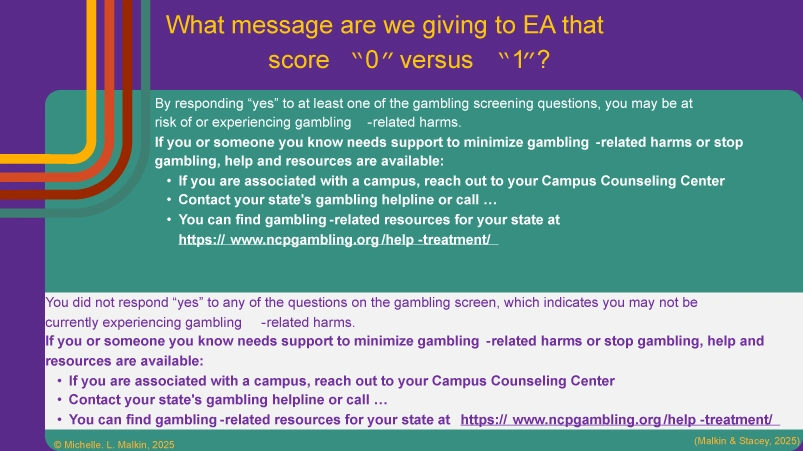
Other useful tips shared included emerging adult gambling risk warning signs to watch for, and ways to help those who are or may become at risk.
Warning signs
- Frequent unexplained absences from work, school, family obligations or other important events
- Unusual interest in newspapers/magazines about stocks, sport scores and/or point spreads
- Excessive phone, text or internet use
- Problems with personal relationships, or withdrawal from family & friends
- Discomfort talking about money or financial management
- Lying about whereabouts; missing household or personal items; the sudden need to borrow money
- Unusual charges on credit card statements
- Visible changes in behavior (severe mood swings, personality or hygiene changes, disturbed sleep or eating patterns) or other symptoms of depression
Ways to help
- Be Proactive – If you observe possible signs of a problem for an emerging adult, seek help and support from various resources.
- Have the conversation – Talk with emerging adults about gambling and its risks
- Help those experiencing gambling-related harms to get support
- Treatment for gambling works, and emerging adults respond well to brief gambling interventions
- Ask college administrators to raise awareness of and address gambling on campuses
- Check out resources at: gamblyticsresearch.com
About
Media inquiries
Legal notice
PLATINUM Contributors




Gold Contributors


The views expressed in the WLA magazine are those of the authors and do not necessarily reflect the views of the WorldLottery Association.

This pop-up contains legal information about this website.
This content is the property of the World Lottery Association (WLA). It may not be transferred
from the custody or control of the WLA except as authorized in writing by an officer of the WLA.
Neither this document, nor the information it contains, may be used, transferred, reproduced,
published, or disclosed, in whole or in part, either directly or indirectly, except as expressly
authorized by an officer of the WLA, pursuant to written agreement.
The WLA Website has been designed to provide information to the lottery community. The World Lottery Association has used great efforts to provide accurate and up-to-date information. However, WLA excludes any warranty, whether express or implied, for any information provided under these pages. WLA cannot be held responsible for any action taken that is based on the information hereunder.
The WLA Website also contains third party information. Such information is, wherever practically possible, marked with the name of the source and does not necessarily represent the opinion of the World Lottery Association. WLA does not take any responsibility whatsoever for such third party information.
The WLA Website also contains links to other Internet sites. WLA does not have any knowledge of the information contained in such other sites, nor has WLA been able to include such other sites in its efforts to provide accurate information. WLA therefore does not take any responsibility whatsoever for such third party information.
All rights reserved except where indicated.
