Tips for achieving WLA responsible gaming certification
Responsible Gaming certification is an ongoing process that allows WLA members to improve their products, services, and RG operations, enhance player experiences, and demonstrate their adherence to best practices and global standards, all of which instils public confidence in our industry.
The WLA is committed to financially supporting its members in achieving Responsible Gaming (RG) certification.
Supporting members through the RG certification process
The WLA partnered with the DigitalRG platform to streamline and simplify the process in one space. In 2024, it became mandatory for members to complete all levels of certification on the Platform, which enables applicants to save time and focus on the submission itself.
Some features include:
- Simplified dashboard, including document management.
- Maximum 10 steps to certification in easy-to-follow sections.
- Simplified question and answer format at each stage, with extra guidance if required.
- Ability to upload proof and evidence at each stage, of RG work undertaken by the lottery.
- IAP report and result published on the dashboard.
- Translation feature allows submissions in languages other than English.
Additionally, the WLA covers the cost of lotteries undergoing level 2 certification for the first time, assumes the annual license fee, and has obtained a perpetual license for the IAP use of the platform to evaluate submissions.
Emphasizing continual progress
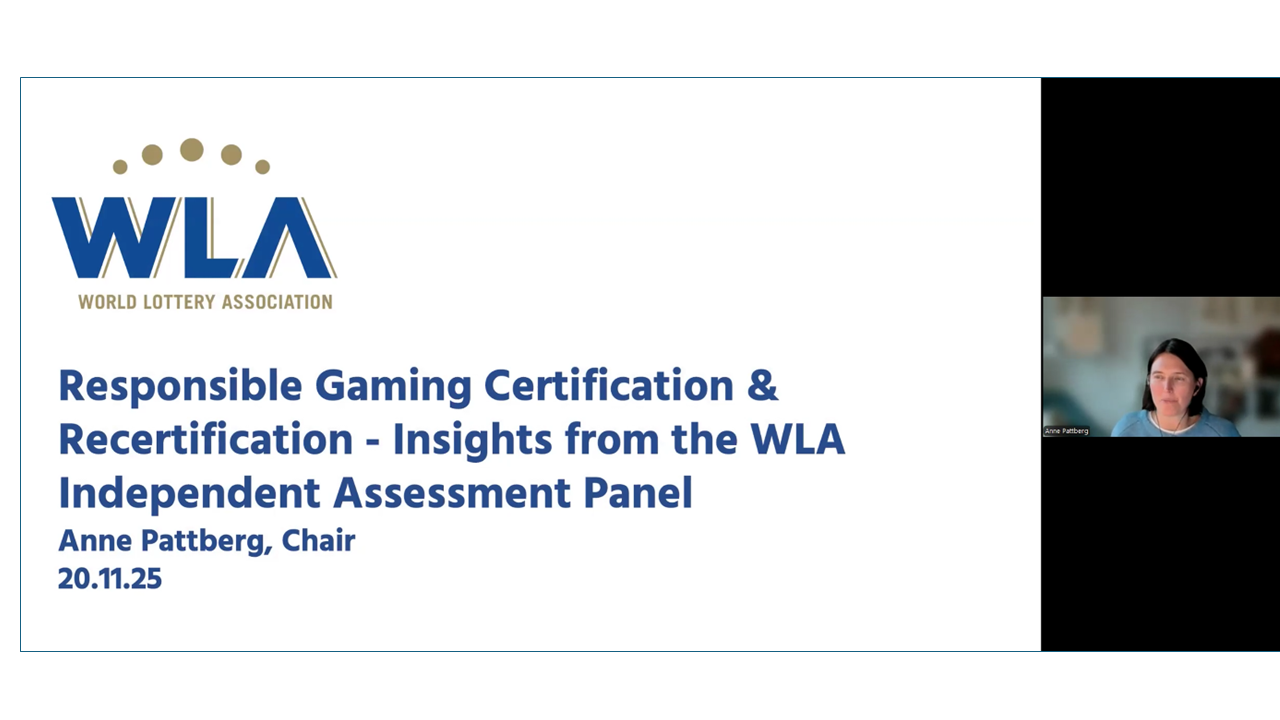
The Independent Assessment Panel (IAP) is comprised of international CSR experts who are tasked with reviewing all submissions and forwarding their certification recommendations to the WLA.
During the 2025 WLA RG webinar week, Anne Pattberg, Chair of the IAP, provided useful insights for RG certification applicants.
There are no submission failures in WLA RG certification, just opportunities to learn, improve and advance through the levels. The WLA Framework was designed to:
- Encourage steady refinement of player protection practices
- Assist lotteries in improving governance, accountability, and transparency
- Promote global consistency in responsible gaming standards
At each level, progress must occur, but the emphasis is on honing practices and building on progress made.
Choosing the recertification level
Recertification occurs every three years. When deciding whether to advance the level or not, applicants should:
- Consider governance maturity, system stability, operational readiness and organizational capacity.
- If maintaining a level is the right choice, submissions must show evolution, such as updated policies, programs, training, or strengthened monitoring, evaluation, or reporting processes.
- It is always helpful to revisit the previous IAP assessment to identify gaps, risks, and areas of strong progress and to consider strategic priorities, resources, and timing.
Demonstrating meaningful progress
There are many ways to show improvements across operations, for instance through:
- Enhanced player protection initiatives
- Staff expansion
- Retailer training
- Improved communication strategies and outreach
- Stronger internal controls or risk detection tools
- Evidence of deeper cross-departmental collaboration
The more details, explanations and evidence provided to demonstrate changes, the better. It is important to provide where possible:
- Examples showing before versus after improvement
- Reasons behind each change
- Include data, KPIs, or evaluation results where available
- Highlight lessons learned and their impact on decisions
Honesty is the best policy:
- Whatever the level it is important to identify any obstacles and capacity limitations and explain how issues are being addressed.
How does the IAP assess recertification?
The IAP does not expect perfection, it looks for continual evolution. Applicants must:
- Demonstrate ongoing improvements
- Not repeat previous submissions
- Show how RG is embedded across the organization with leadership support
- Include monitoring, evaluation, and learning processes
- Show the link between continual improvements and outcomes
Pattberg described the goal of recertification as the strengthening of responsible gaming sustainably, cycle after cycle. She noted that a strong submission requires applicants to have updated standards and player-protection measures in place for vulnerable groups. It should contain risk-mitigation tools. There should be engagement with stakeholders, including regulators, NGOs, researchers, and retailers. Decisions for improvement should be based on data and research, and finally, the content should be clean, structured, and concise.
About
Media inquiries
Legal notice

PLATINUM Contributors




Gold Contributors


The views expressed in the WLA magazine are those of the authors and do not necessarily reflect the views of the WorldLottery Association.

This pop-up contains legal information about this website.
This content is the property of the World Lottery Association (WLA). It may not be transferred
from the custody or control of the WLA except as authorized in writing by an officer of the WLA.
Neither this document, nor the information it contains, may be used, transferred, reproduced,
published, or disclosed, in whole or in part, either directly or indirectly, except as expressly
authorized by an officer of the WLA, pursuant to written agreement.
The WLA Website has been designed to provide information to the lottery community. The World Lottery Association has used great efforts to provide accurate and up-to-date information. However, WLA excludes any warranty, whether express or implied, for any information provided under these pages. WLA cannot be held responsible for any action taken that is based on the information hereunder.
The WLA Website also contains third party information. Such information is, wherever practically possible, marked with the name of the source and does not necessarily represent the opinion of the World Lottery Association. WLA does not take any responsibility whatsoever for such third party information.
The WLA Website also contains links to other Internet sites. WLA does not have any knowledge of the information contained in such other sites, nor has WLA been able to include such other sites in its efforts to provide accurate information. WLA therefore does not take any responsibility whatsoever for such third party information.
All rights reserved except where indicated.
